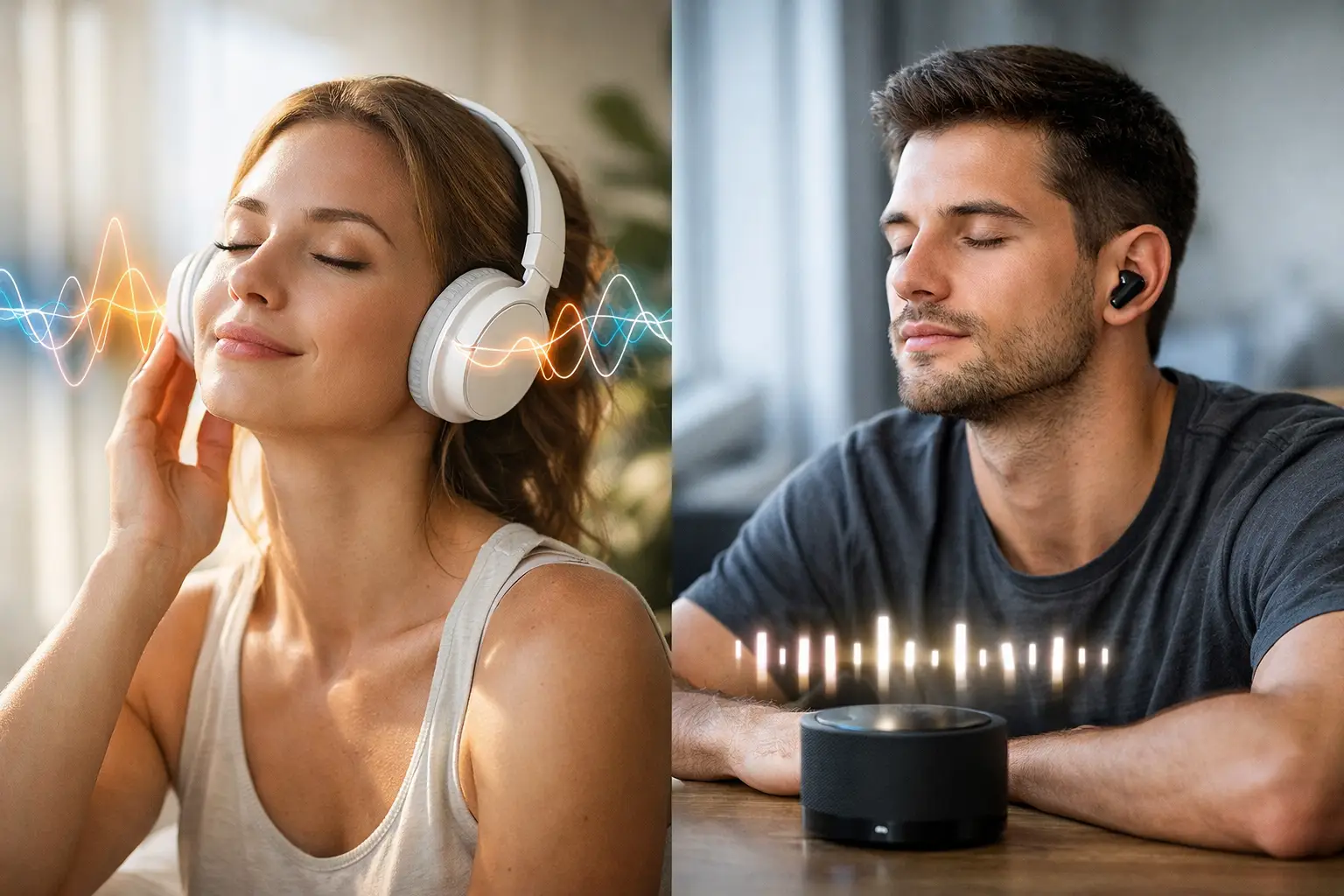
You put on headphones hoping for sharper focus, less mental noise, and maybe a little relief from that midday cognitive drag. Then you hit the same question almost everyone hits: binaural beats vs isochronic tones – which one actually works better for the result you want?
The short answer is that both are forms of brainwave entrainment audio, but they are not the same experience, and they do not fit every goal equally well. If your priority is deep concentration, calmer thinking, or a more reliable path into flow, the right choice depends on how your brain responds, how you listen, and what kind of result you need from the session.
Binaural beats vs isochronic tones: what’s the difference?
Binaural beats are created when each ear hears a slightly different frequency. Your brain processes the difference between those tones and perceives a third rhythmic beat. For example, if one ear hears 200 Hz and the other hears 210 Hz, your brain may perceive a 10 Hz beat. Because of that setup, headphones are essential.
Isochronic tones work differently. Instead of relying on two separate frequencies, they use a single tone that pulses on and off at a specific rhythm. That pulse is clear, distinct, and evenly spaced. You can listen with speakers or headphones, although headphones can still improve the experience.
From a user perspective, binaural beats often feel smoother and more atmospheric. Isochronic tones usually feel more direct and noticeable. Some people find binaural beats easier to relax into. Others feel isochronic tones are more effective because the stimulation is more obvious.
That difference matters more than it may seem. Brain entrainment is not just about theory. It is about whether you will actually use it consistently enough to notice a change in focus, mood, or mental energy.
How each one affects your listening experience
If you already feel mentally overloaded, sound design matters. Binaural beats are usually blended into ambient audio, music, or soft background textures. That can make them feel premium, calming, and easy to incorporate into a morning routine, a focus block, or a wind-down session.
Isochronic tones tend to have a sharper, more mechanical pulse. Some listeners love that because it feels structured and intentional. Others find it distracting, especially during tasks that already require a lot of cognitive effort.
This is where personal preference becomes performance relevant. The most technically precise audio in the world will not help much if it irritates you after three minutes. For busy professionals and creatives, the best protocol is the one you will return to daily without resistance.
Which is better for focus?
For focus, the answer is not absolute, but there is a practical pattern. Isochronic tones are often described as stronger or more stimulating because the rhythmic pulse is so defined. That can make them appealing for alertness, concentration, and cognitive activation.
At the same time, stronger is not always better. If you are already running on too much caffeine, too many tabs, and a nervous system that never fully settles, a more aggressive listening experience can feel like one more demand on your attention. In those cases, binaural beats may offer a smoother entry into concentration by reducing friction and helping the mind settle before it sharpens.
For many people chasing true flow, the real target is not just alertness. It is calm focus. That balance matters. You do not want to feel sedated, but you also do not want your brain humming with tension. That is why higher-quality entrainment tracks often layer frequencies and sound design in a more intentional way rather than forcing a single blunt effect.
Which is better for relaxation and sleep?
If your goal is relaxation, stress reduction, or sleep support, binaural beats often win on comfort. Their softer presentation can feel less intrusive, which helps when the goal is to slow down mental chatter rather than energize the mind.
Isochronic tones can still be used for calming states, but some listeners remain too aware of the pulsing. If you are highly sensitive to sound, or if repetitive audio easily grabs your attention, that can work against relaxation.
That said, some people respond extremely well to the clear structure of isochronic pulses, even for meditation or sleep preparation. This is one of those areas where experimentation matters more than claims. The same audio that one person finds soothing may feel sterile or distracting to someone else.
The science is promising, but expectations should stay realistic
Brainwave entrainment is an interesting area of neuroscience and wellness, but it should not be treated like magic. Some studies suggest that auditory stimulation may help influence brain states related to relaxation, attention, or mood. At the same time, results vary by protocol, frequency, individual sensitivity, and consistency of use.
That means the better question is not whether binaural beats or isochronic tones are universally superior. The better question is whether a given audio protocol helps you feel and perform better in a repeatable way.
For high-performers, that practical lens is useful. You are not looking for hype. You are looking for something that helps you think clearly, reduce mental fatigue, and stay on task without adding another complicated routine to your life.
Binaural beats vs isochronic tones for daily performance
If your day involves deep work, decision-making, creativity, or sustained mental output, the ideal audio is one that supports state change with minimal effort. That is where design quality matters more than format alone.
A generic binaural beat track may sound pleasant but do very little for your actual productivity. A raw isochronic tone may be stimulating but too harsh to use every day. The strongest results usually come from audio built around a specific cognitive outcome, with frequencies sequenced intentionally and wrapped in a listening experience people can stick with.
That is exactly why premium brain optimization audio has moved beyond the basic debate of binaural beats vs isochronic tones. The real advantage comes from precision. Which frequencies are used, in what order, for how long, and for what mental state? Those details shape the outcome.
For readers who want a simpler path to sharper focus and flow, The FlowWave Audio “Unlock Your Deep Flow” is built for that exact need. You can find it here: https://flowwave-neuroflowlabs.lovable.app It is a 15-minute daily protocol designed to support deep focus, reduce mental fatigue, and help your brain transition into a more productive state without pills, complicated routines, or hour-long meditation sessions. When your mind starts feeling scattered, what you need is not more effort. You need the right signal.
How to choose the right one for you
If you are deciding what to try first, start with your goal. For sleep, stress relief, and softer mental downshifting, binaural beats are often the more comfortable place to begin. For alertness, motivation, or task-focused sessions, isochronic tones may feel more immediate.
Then consider your environment. If you cannot reliably use headphones, binaural beats become less practical. Isochronic tones are more flexible in that sense. If you work in an office, travel often, or need a discreet routine, convenience matters.
Finally, consider your nervous system. If you are already overstimulated, choose audio that helps you feel grounded before it tries to amplify focus. If you tend to feel sluggish, foggy, or mentally flat, a more pronounced rhythmic stimulus may be useful.
The smartest approach is to notice your response over a week or two, not a single session. Pay attention to whether you feel more focused, calmer, less fatigued, or more mentally organized afterward. The best result is not a dramatic sensation during listening. It is better performance after listening.
What matters more than the debate
There is a temptation to keep comparing formats, frequencies, and terms until the whole thing becomes another research project. But if your real problem is brain fog, inconsistent concentration, or difficulty entering flow, the bigger win is finding a system you can trust and actually use.
Binaural beats and isochronic tones are both tools. Neither one is automatically the answer. The right audio should feel effective, easy to repeat, and aligned with the state you want to create.
If your mind has been working harder than it should just to stay clear, that is not a personal failure. It is a signal to work with your brain more intelligently. Sometimes the fastest way back to focus is not forcing yourself harder. It is giving your brain the conditions it needs to perform well.
Leave a Reply