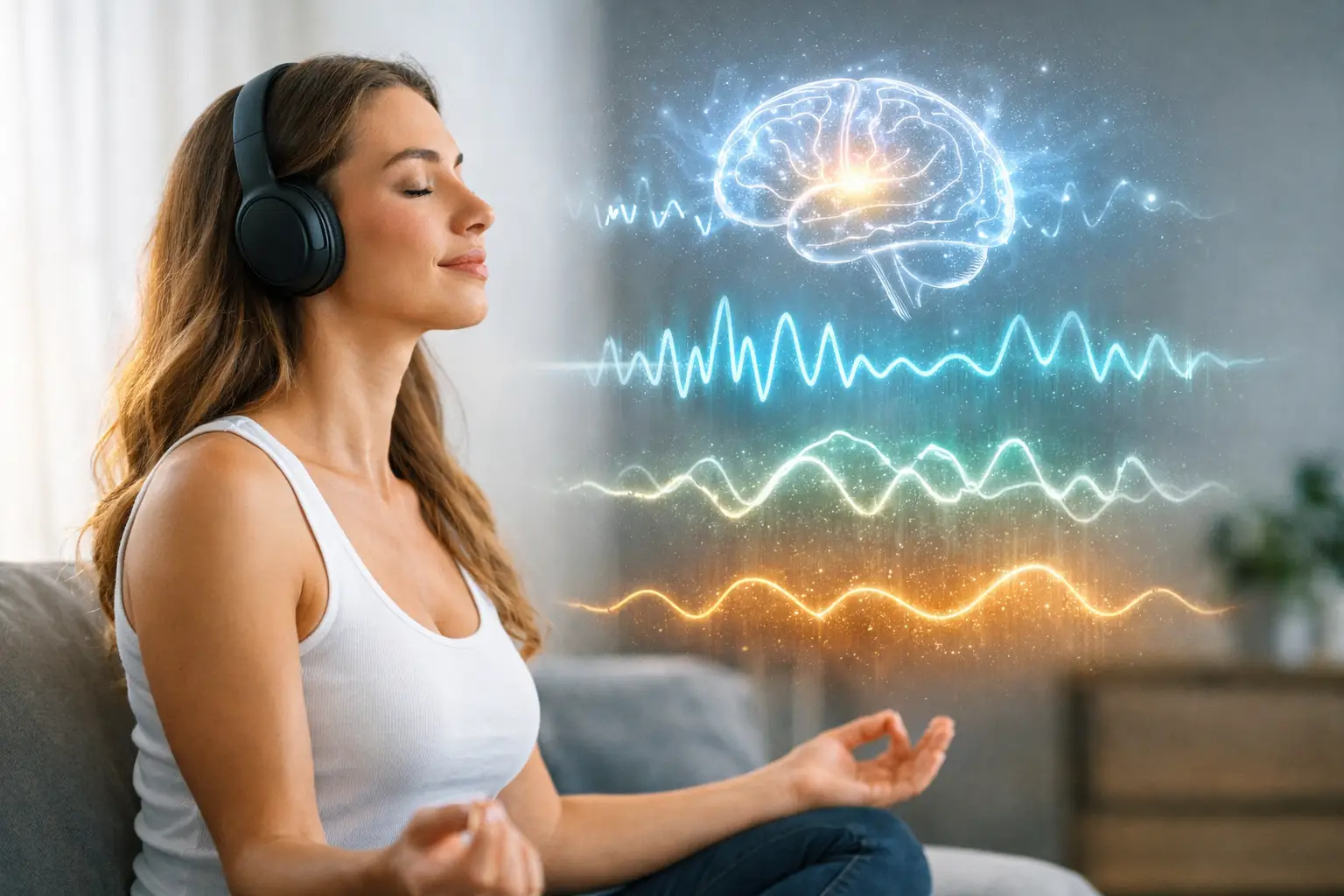
Your brain does not feel the same at 8:30 a.m. on a focused work streak as it does at 3:00 p.m. when your attention is scattered and your coffee has stopped helping. That shift is part of what this guide to brainwave frequencies is really about – understanding the changing electrical patterns behind focus, calm, creativity, sleep, and mental fatigue, so you can work with your brain instead of pushing against it.
For ambitious professionals, creatives, and founders, that matters. When your thinking feels sharp, everything moves faster. Decisions get cleaner. Memory feels more reliable. Work stops feeling like friction and starts feeling like flow. Brainwave frequencies are not magic, but they can be a practical framework for understanding why some states feel effortless and others feel mentally expensive.
What brainwave frequencies actually are
Brainwave frequencies are patterns of electrical activity produced by groups of neurons communicating in the brain. They are measured in hertz, or cycles per second. Different frequency ranges tend to be associated with different mental states, although real life is rarely as simple as one frequency equaling one feeling.
That distinction matters. Your brain is not locked into a single state. It moves dynamically across multiple frequencies depending on what you are doing, how rested you are, how stressed you feel, and what kind of cognitive demand is in front of you. The goal is not to live in one brainwave state all day. The goal is to access the right state at the right time, with less effort.
A practical guide to brainwave frequencies by state
Delta waves
Delta waves are the slowest brainwaves, generally linked with deep, dreamless sleep and physical restoration. This is the state most associated with recovery. If you are chronically sleep-deprived, your brain often struggles to support higher-order functions the next day, no matter how good your systems are.
Delta is important, but not because you need more of it during a work sprint. It matters because cognitive performance starts with recovery. If your sleep is broken, your focus problem may not really be a focus problem.
Theta waves
Theta sits above delta and is often connected with drowsiness, light sleep, deep meditation, memory processing, and vivid internal imagery. It can also show up during highly creative or intuitive states.
Theta has an interesting trade-off. It can support insight, imagination, and emotional processing, but too much theta at the wrong time can feel like brain fog, drifting attention, or difficulty staying mentally locked in. For a writer brainstorming concepts, that may be useful. For an executive reviewing contracts, probably not.
Alpha waves
Alpha is often described as the bridge between relaxation and alertness. It is associated with a calm, present, wakeful state – not sleepy, not overstimulated. Many people notice alpha-like states when they feel settled, clear, and mentally open.
This is one of the most valuable frequencies for modern high performers because it often helps reduce internal noise without flattening energy. If your mind feels busy, reactive, or overstretched, alpha may be part of what is missing. It creates the conditions for focus by calming the static.
Beta waves
Beta is commonly linked to active thinking, concentration, problem-solving, and outward attention. This is the state you rely on for meetings, planning, analysis, and execution.
But beta has a range. Healthy beta can feel productive and engaged. Excessive high beta can feel tense, wired, and mentally overclocked. That is why some people seem alert but still cannot concentrate deeply. Their brain is active, but not organized. More stimulation is not always better.
Gamma waves
Gamma is the fastest of the commonly discussed brainwave ranges and is often associated with high-level information processing, memory integration, learning, and peak cognitive performance. Some research links gamma activity with moments of heightened awareness and unified perception – the kind of state where everything clicks.
This is part of why gamma gets attention in performance and brain optimization circles. It appears to play a role in sharper cognition and mental integration. At the same time, it is not a switch you force on command. The most effective approaches usually help the brain move into gamma-supportive states through a sequence, rather than trying to jump straight there.
Why brainwave balance matters more than chasing one perfect state
A lot of content on this topic makes it sound as if one frequency is the answer to everything. That is rarely true. The brain performs best when it can transition fluidly.
You want alpha when you need calm clarity. You want beta when it is time to execute. You may benefit from theta during creative ideation and delta during deep sleep. Gamma can support moments of high integration and peak output. What matters is adaptability.
This is especially relevant if you have been dealing with brain fog, mental fatigue, or inconsistent focus. Often the issue is not that your brain is failing. It is that your nervous system is spending too much time in the wrong mode for the task at hand.
Can sound influence brainwave states?
In some cases, yes. This is where brainwave entrainment enters the conversation. Brainwave entrainment uses rhythmic auditory stimulation to encourage the brain to synchronize with specific frequencies. Common methods include binaural beats and isochronic tones.
The basic idea is simple. Present the brain with carefully structured sound patterns, and it may begin to align its activity in that direction. The science is promising, but results can vary from person to person. Factors like consistency, audio quality, baseline stress, sleep, and the specific frequency design all matter.
That is also why generic background tracks often disappoint. If the sequencing is vague or the intended outcome is too broad, you may get a nice ambient experience without a meaningful shift in mental state. For people who want real cognitive support, precision matters.
How to use this guide to brainwave frequencies in real life
Start by matching the state to the outcome. If your mind is racing before a big work block, calming into alpha first may be more useful than trying to force intense concentration immediately. If you are dragging in the afternoon, you may need a protocol that supports a transition from calm alertness into sharper high-frequency focus, not just relaxing music.
Consistency matters more than intensity. A short daily session is usually more realistic and more effective than an occasional hour-long experiment. This is one reason focused audio protocols appeal to busy professionals – they reduce friction. No pills, no complicated routines, no need to clear half your day for meditation.
Timing matters too. Some people respond best early in the morning, when the brain is more impressionable and attention has not yet been fragmented. Others benefit most before deep work, creative sessions, or any task where mental endurance is critical. It depends on your rhythm and your biggest cognitive bottleneck.
Where FlowWave Audio fits
If you are looking for a practical solution rather than a science hobby, The FlowWave Audio “Unlock Your Deep Flow” at https://flowwave-neuroflowlabs.lovable.app/ was designed for exactly that gap. Instead of asking you to figure out frequencies on your own, it uses a structured 15-minute sequence that moves from Alpha into Gamma 40 Hz, paired with 432 Hz tones, to help support deep focus, mental clarity, and a more effortless flow state.
The real value is simplicity. When your brain already feels overloaded, the last thing you need is another complicated optimization stack. A precise, repeatable listening protocol can become the easiest part of your performance routine – the kind of small daily decision that quietly changes how you think, work, and recover. Once you experience what it feels like to access cleaner focus without forcing it, it becomes harder to settle for the usual cycle of distraction, fatigue, and pushing through.
What to keep in mind before trying brainwave entrainment
It helps to stay grounded. Brainwave audio is a tool, not a replacement for sleep, stress management, or medical care. If you are severely burned out, chronically sleep-deprived, or dealing with significant cognitive symptoms, broader support may be needed.
It is also worth noticing your own response instead of expecting a dramatic movie-scene transformation. Sometimes the benefit is subtle at first. You may simply find it easier to begin work, stay with a task longer, remember details more clearly, or finish the day with less mental depletion. Those are meaningful changes.
The best mindset is curiosity with standards. You do not need hype. You need something that helps your brain feel calmer, sharper, and more capable in a way that fits real life.
When you understand brainwave frequencies, you stop treating focus like pure willpower and start seeing it as a state you can support. And for people who want to do exceptional work without burning out, that shift can change more than productivity – it can change how your whole day feels.
Leave a Reply