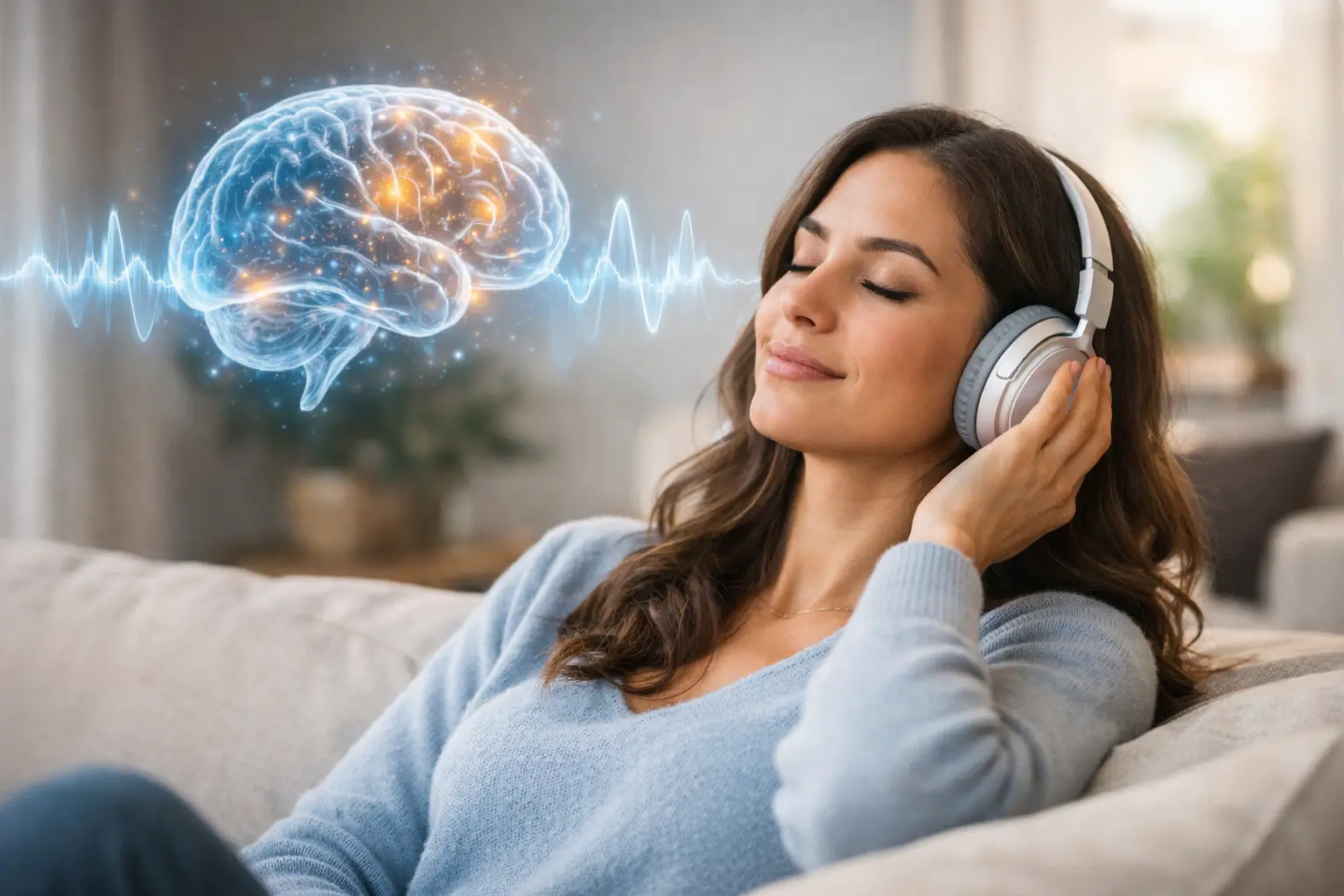
Your calendar may be full, but the real pressure often arrives before the first meeting: a mind already split between messages, unfinished decisions, and the quiet fear that your focus is not as reliable as it used to be. The future of brain health audio is not about adding more noise to that experience. It is about using sound with greater intention – to create a clearer transition into calm, concentrated work.
For ambitious professionals, creators, and entrepreneurs, brain health is becoming less of an abstract long-term goal and more of a daily performance need. You want to remember what matters, make sharper decisions, recover from mental strain, and still have something left for the people and projects you care about. Audio may become one of the most accessible tools in that equation because it asks so little of an already overloaded day.
Why Brain Health Audio Is Moving Beyond Relaxation
For years, wellness audio largely meant sleep playlists, nature sounds, or guided meditations. Those can be useful, especially when stress is high. But they do not always match the moment when you need to write a proposal, study complex material, solve a difficult problem, or move through a demanding afternoon without another coffee.
The next generation of brain health audio is more purposeful. It is designed around states of attention, restoration, and cognitive readiness rather than general relaxation alone. Think of it less as background music and more as a repeatable cue: a short listening ritual that tells your brain it is time to settle, narrow its focus, and begin.
That distinction matters. Your brain responds to context. The same desk, headphones, and sound sequence used before a focused work block can become a learned signal over time. You are not waiting for motivation to appear. You are creating conditions that make starting easier.
The Future of Brain Health Audio Will Be More Personal
No two people experience brain fog the same way. One person is mentally sharp in the morning but fades at 2 p.m. Another can think clearly until notifications fracture their attention. A creative may need a calmer entry into work, while an executive may need to shift quickly from reactive communication to strategic thought.
That is why personalization is likely to shape the future of brain health audio. Rather than one generic track for every need, people will increasingly choose audio based on the state they want to support: focused work, creative ideation, mental reset, memory practice, or pre-sleep decompression.
The best approach will not necessarily be the most complicated. More data is not always more helpful. A wearable can reveal useful patterns around sleep, stress, and recovery, but it cannot replace self-awareness. The more practical question is simple: What does your mind need right now, and what helps you return to that state consistently?
For many people, that may mean a 15-minute focus session before deep work. For others, it may mean a short reset between meetings. The value is in matching the audio ritual to a real friction point in your day.
Brainwave Entrainment Deserves Both Curiosity and Perspective
Brainwave entrainment audio uses rhythmic sound patterns, including binaural beats or other pulsed tones, intended to support brain activity associated with particular mental states. Alpha frequencies are often associated with relaxed alertness, while higher-frequency gamma activity has been studied in connection with attention and cognitive processing.
This is an interesting area of research, but it should not be framed as a miracle switch. Responses vary by person, track design, listening environment, sleep quality, stress level, and expectations. Research into auditory stimulation and cognitive outcomes is promising in some areas, yet it remains mixed and continues to develop.
That does not make the practice meaningless. It means the most intelligent use is practical and grounded. Treat brain health audio as a supportive part of a larger mental performance system, not a substitute for sleep, movement, medical care, meaningful relationships, or focused work habits.
From Passive Listening to a Daily Cognitive Ritual
The strongest benefit of audio may be behavioral. When your attention is scattered, the hardest part of deep work is often not the work itself. It is crossing the threshold from distraction into engagement.
A consistent audio protocol can help reduce that transition cost. Put on headphones, clear the obvious distractions, start the session, and give yourself permission to work on one meaningful task. The ritual creates a boundary around your attention in a world built to interrupt it.
This is where simplicity wins. You do not need an elaborate morning routine with twelve supplements, an ice bath, and a detailed tracking dashboard. If a 15-minute audio session helps you arrive calmer and more focused, it is a routine you are far more likely to repeat when life gets demanding.
The FlowWave Audio was built around that idea. Its 15-minute protocol combines a progression from Alpha to Gamma 40 Hz frequencies with 432 Hz tones to support a focused, clear-headed entry into demanding work. It is designed for people who want a low-friction way to prepare for deep focus – no pills, no complicated routines, and no need to carve an hour out of the day. You can find it here: https://flowwave-neuroflowlabs.lovable.app
The difference is subtle but powerful: instead of hoping your mind will cooperate, you begin creating a dependable signal that it is time to perform.
What Audio Cannot Replace
Brain optimization should never become another form of pressure. If you are chronically exhausted, struggling with anxiety, noticing significant memory changes, or feeling persistently low, an audio track is not the complete answer. Those experiences deserve support from qualified health professionals.
Likewise, no sound protocol can compensate for consistently poor sleep, a chaotic workload, dehydration, or a life with no recovery time. Audio can improve the quality of a focus ritual, but it cannot make an unrealistic pace sustainable.
There are practical safety considerations, too. Keep volume at a comfortable level. Do not use headphones while driving or during tasks that require full awareness of your surroundings. If you have a neurological condition, experience sound sensitivity, or have concerns about using rhythmic stimulation, speak with a qualified clinician first.
The goal is not to force your brain into productivity at any cost. It is to support attention without abandoning recovery.
How to Use Brain Health Audio More Effectively
Start by choosing one moment when your mind reliably loses momentum. It may be the first 20 minutes of your workday, the hour after lunch, or the transition from meetings into meaningful individual work. Use audio at that same moment for five to seven days before judging the result.
During the session, remove competing inputs. Silence notifications, close unnecessary tabs, and decide on one concrete task before pressing play. Audio works best when it supports a clear intention rather than competes with ten open priorities.
Pay attention to outcomes that actually matter. Did it take less time to begin? Did you stay with the task longer? Did you feel less mentally drained afterward? Did you make fewer careless mistakes? These signals are more useful than chasing an intense sensation or expecting instant transformation.
It also helps to vary the goal. A calm, low-stimulation session may be better before reflective planning or writing. A more activating protocol may fit analytical work, studying, or a focused creative sprint. The right audio depends on the work in front of you and the state you are starting from.
A More Human Vision for Cognitive Performance
The future of brain health audio should not be about turning people into machines. The better vision is more human: helping you protect attention, reduce unnecessary mental friction, and create room for your best thinking.
When used wisely, sound can become a small but meaningful part of how you care for your mind. Not another demand on your schedule. Not an escape from the work that matters. Just a simple, repeatable way to arrive with more clarity when your next important moment begins.
Give your mind a consistent cue to slow the noise, gather its energy, and focus on what deserves your full attention.
Leave a Reply