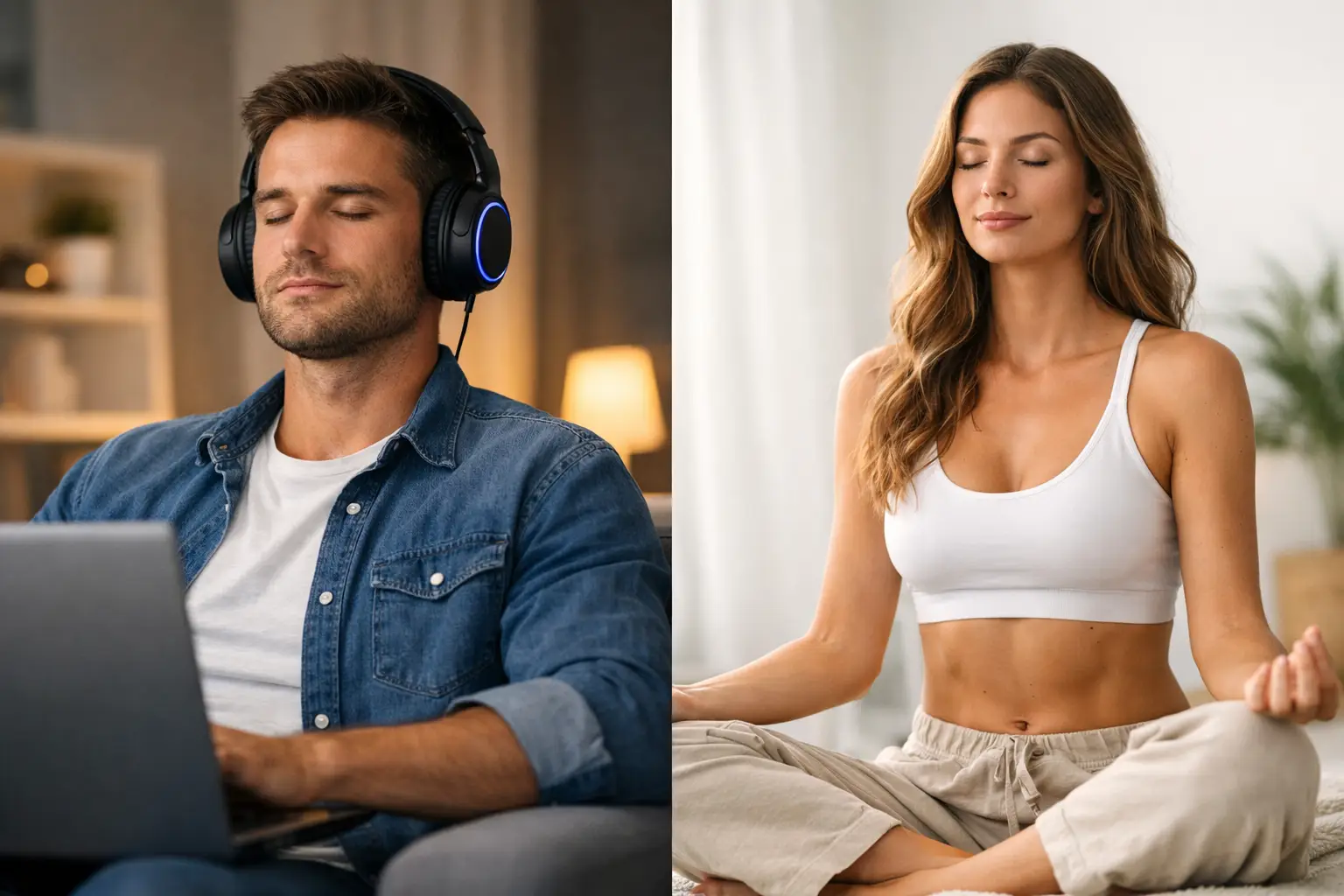
If you have ever sat down to meditate and spent the whole time wrestling with your own thoughts, you are not alone. For a lot of high-performing adults, the real question is not whether mental training works. It is whether brainwave entrainment vs meditation is the better fit for a busy mind that needs results, not another routine to fail at.
Both can help you feel calmer, more focused, and less mentally cluttered. But they do it in very different ways. Meditation usually asks you to actively guide your attention. Brainwave entrainment uses carefully designed sound frequencies to help nudge your brain into a desired state. One builds skill through practice. The other reduces friction and helps create the conditions for the state you want.
That difference matters when you are dealing with brain fog, decision fatigue, and a calendar that already feels too full.
Brainwave entrainment vs meditation: what is the real difference?
Meditation is an internal practice. You focus on your breath, a word, a sensation, or simple awareness itself. Over time, you learn to notice distraction without getting pulled around by it. That can improve emotional regulation, stress resilience, and self-awareness. It is powerful, but it is also a skill. And like any skill, it takes repetition.
Brainwave entrainment is more external. It uses rhythmic auditory stimulation, often through binaural beats or other sound-based protocols, to encourage the brain to synchronize with certain frequencies. Different frequency ranges are associated with different mental states. Alpha is often linked with relaxed alertness. Theta tends to show up in deeper relaxation and inward focus. Gamma is associated with higher-order processing, attention, and cognitive integration.
In plain English, meditation asks you to create the state from the inside out. Brainwave entrainment helps cue the state from the outside in.
Neither approach is automatically better in every situation. It depends on what you want, how your brain responds, and how much effort you are realistically willing to give.
Why meditation works well for some people
Meditation has earned its reputation for a reason. Done consistently, it can change how you relate to stress, distraction, and emotional reactivity. If your biggest challenge is feeling hijacked by your thoughts, meditation can be deeply valuable because it teaches you not to chase every mental impulse.
It can also support sleep, patience, and a steadier mood. For people who enjoy introspection and are willing to practice without immediate payoff, meditation often becomes more effective with time.
The trade-off is that many ambitious professionals struggle with the early stages. If your brain is already overclocked, sitting still with your own thoughts can feel frustrating instead of calming. You may know meditation is good for you and still avoid it because it feels like work at the exact moment you are already mentally drained.
That does not mean you are bad at meditation. It usually means your current state is making access harder.
Where brainwave entrainment can feel easier
This is where brainwave entrainment stands out. It lowers the activation energy. You press play, put on headphones, and let the audio do part of the heavy lifting.
For people who want sharper focus without turning it into a spiritual practice or a 45-minute ritual, that simplicity is a real advantage. It can be especially appealing if you are dealing with afternoon crashes, scattered attention, or the sense that your mind is technically on but not fully online.
Used well, entrainment can help create a faster shift into calm concentration or deeper flow. That is one reason it resonates with entrepreneurs, creatives, and knowledge workers who need performance support as much as stress relief.
The trade-off is that entrainment is not the same as building long-term attentional discipline from scratch. It can help you access a state more easily, but it does not automatically teach the same self-observation skills meditation develops over time.
Brainwave entrainment vs meditation for focus, stress, and flow
If your goal is stress reduction alone, both can help. Meditation may offer broader emotional benefits because it changes how you respond to stressors, not just how you feel in the moment. Brainwave entrainment may feel faster because it helps shift your state without asking you to actively manage every thought.
If your goal is deep focus, the gap can become more obvious. Traditional meditation is not always designed for task-oriented performance. It can improve attention overall, but many forms are centered on awareness, presence, or compassion rather than entering a cognitively sharp work state on demand.
Brainwave entrainment can be better aligned with that goal, especially when the audio is engineered around focus-related frequencies instead of generic relaxation. That makes it a practical fit for someone who needs to write, solve, create, analyze, or make decisions at a high level.
For flow states, it depends on what blocks you. If your main issue is internal noise, meditation may help by reducing mental friction over time. If your main issue is getting your brain to settle into the right rhythm quickly, entrainment may feel more direct.
Which one is better for busy professionals?
For many adults between 35 and 55, the real constraint is not interest. It is bandwidth. You may fully believe in mindfulness and still not want another habit that requires patience before it pays off.
That is why brainwave entrainment often appeals to people who are stretched thin but still want a high-functioning mind. It is passive, structured, and low effort. You do not need to wonder whether you are doing it right. You simply create the space, listen, and let the protocol guide the shift.
Meditation can absolutely be worth building if you want a lifelong inner practice. But if what you need right now is clearer thinking, less mental fatigue, and a smoother path into focused work, entrainment may be the more realistic starting point.
Realistically, the best method is often the one you will actually use.
Can you use brainwave entrainment and meditation together?
Yes, and for many people that is the smartest approach.
Brainwave entrainment can make meditation easier by calming mental chatter before you begin. Meditation can deepen the benefits of entrainment by helping you become more aware of your internal state and less reactive throughout the day. One supports access. The other supports mastery.
You do not have to choose them as opposing camps. Think of them as different tools for different moments. On a chaotic workday, entrainment may be the cleanest path to mental clarity. On a quieter morning or evening, meditation may help you build steadier awareness and emotional range.
This is also where product quality matters. Generic soundtracks marketed as focus music are not the same as a targeted brain optimization protocol. If you want an audio-based solution that is built for cognitive performance rather than background relaxation, The FlowWave Audio Unlock Your Deep Flow at https://flowwave-neuroflowlabs.lovable.app/ is designed to help you move into sharper focus, reduced mental fatigue, and more effortless flow in just 15 minutes a day. For someone who wants a simpler path to a calmer, clearer, more productive mind, that kind of structure can remove a lot of resistance.
How to decide what fits you right now
If you are naturally reflective, patient, and interested in the long game of mental training, meditation may be worth committing to. If you want a deeper relationship with your thoughts and emotions, it offers something uniquely valuable.
If you are overwhelmed, mentally tired, and mainly want reliable access to concentration and calm without adding complexity, brainwave entrainment may fit better. It meets a lot of busy people where they actually are, not where they wish they were.
You can also ask a simpler question: do you need practice, or do you need support?
Meditation is excellent practice. Brainwave entrainment is excellent support. Sometimes support is exactly what allows practice to become possible later.
There is no prize for choosing the harder option if the easier one helps you show up better at work, think more clearly, and end the day with more energy left for your life.
A sharper mind does not always come from forcing more effort. Sometimes it comes from choosing tools that work with your brain instead of against it. If meditation has felt difficult, that does not mean you are failing. It may just mean you are ready for a method that helps your mind meet you halfway.
Leave a Reply