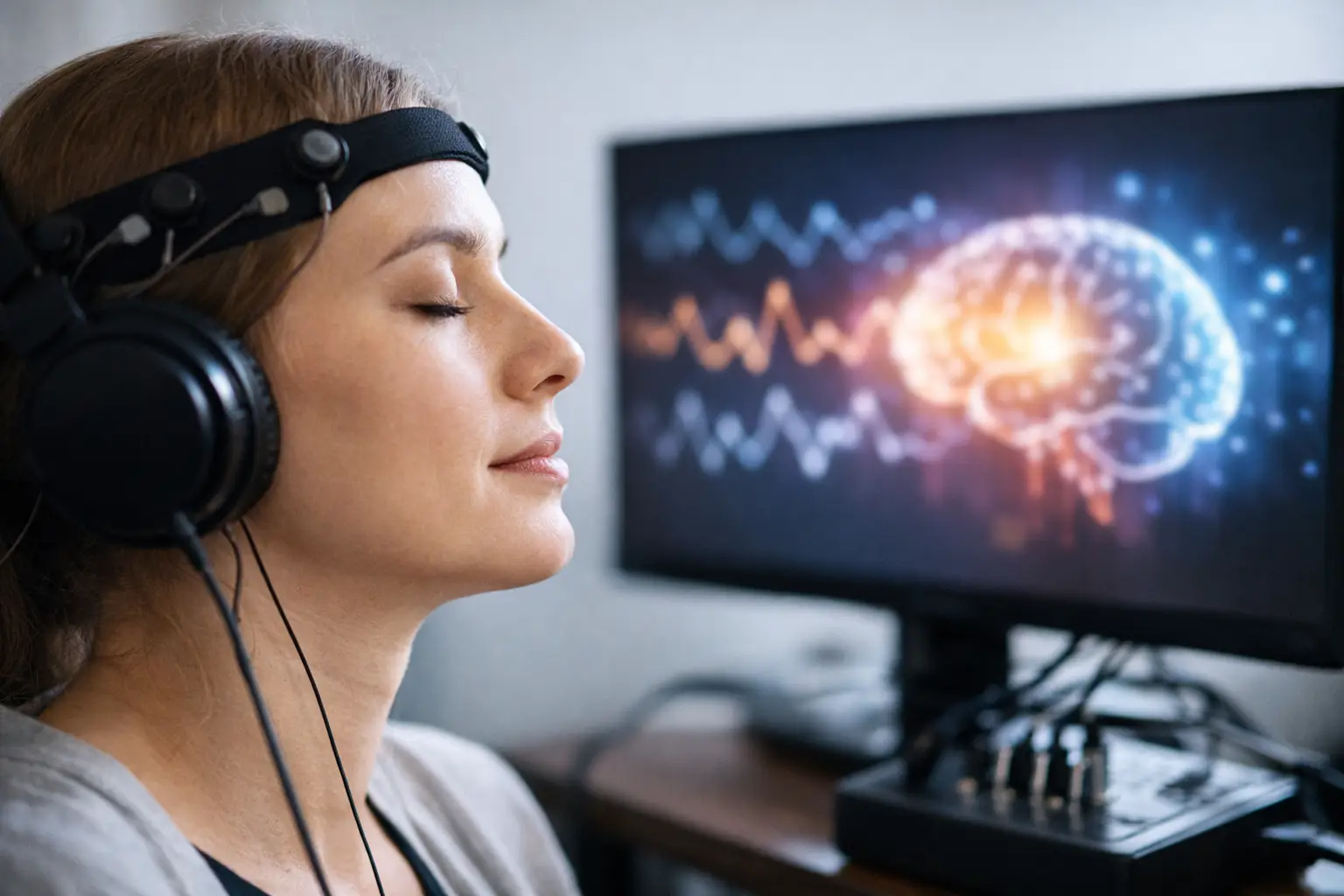
You can feel the difference between a scattered brain and a focused one within minutes. One moment, your attention is fractured, your thoughts are jumping, and even simple tasks feel heavier than they should. The next, your mind is steady, clear, and fully engaged. How brainwave entrainment works comes down to a simple idea: the brain tends to synchronize with repeating sensory patterns, especially sound.
That idea matters because your mental state is not random. Focus, creativity, relaxation, and deep work each tend to correlate with different patterns of brain activity. Brainwave entrainment uses carefully timed audio pulses or tones to encourage the brain toward those patterns. It is not mind control, and it is not magic. It is a way of giving your brain a rhythmic cue it can follow.
What brainwave entrainment is actually doing
Your brain is always producing electrical activity. These patterns are commonly described in frequency bands such as Delta, Theta, Alpha, Beta, and Gamma. Each band is associated with different types of mental experience. Alpha is often linked with calm alertness. Beta is more associated with active thinking and problem-solving. Gamma has been studied for attention, memory, and higher-level cognitive processing.
Brainwave entrainment audio is designed to present a consistent rhythm that your auditory system can detect. When that rhythm is repeated in the right way, the brain may begin to align some of its activity with the external stimulus. This is often called the frequency-following response. In practical terms, your brain hears a pattern and starts to mirror it.
That mirroring is the core of how brainwave entrainment works. If the audio is built around frequencies associated with relaxed focus, you may feel calmer and more centered. If it is structured to support alert concentration, you may notice sharper attention and less mental drag. The effect is not identical for every person, but the mechanism is based on rhythm, repetition, and neural responsiveness.
How brainwave entrainment works with sound
Most people experience brainwave entrainment through headphones or speakers using binaural beats, isochronic tones, or layered rhythmic pulses. Each approach uses sound a little differently.
Binaural beats happen when one ear hears a tone at one frequency and the other ear hears a slightly different frequency. Your brain processes the difference between them as a perceived beat. Isochronic tones use evenly spaced pulses of sound that turn on and off at a targeted rhythm. Some audio programs combine methods with ambient soundscapes or tonal layers to make the experience more pleasant and easier to use consistently.
The key is not just hearing a sound. It is hearing a precise rhythm over enough time for the nervous system to respond. That is why random background music does not produce the same effect. Entrainment audio is intentional. The timing, sequencing, and frequency targets are chosen to guide the listener toward a desired mental state.
For someone dealing with brain fog, constant task switching, or afternoon fatigue, this can be appealing because it asks very little of you. You are not trying to force concentration through willpower. You are giving your brain an external structure that may make focus feel more natural.
Why different frequencies feel different
Not all entrainment audio is aiming at the same outcome. That is where nuance matters. A track designed for deep relaxation may leave you too soft for strategic work. A track built for high alertness may feel too activating if you are already overstimulated.
Alpha-range stimulation is often used to support calm clarity. This can be useful when your mind feels noisy but you still need to think clearly. Gamma-related protocols are often discussed in relation to attention, memory, and mental integration. A sequence that moves from Alpha into Gamma may feel more balanced than jumping straight into an intense state, especially if your nervous system is already carrying stress.
This is one reason sequencing matters so much. The brain does not always respond best to a single static frequency. In some cases, it benefits more from a progression that helps it settle first, then sharpen. For high-performers who need to move from mental clutter into productive flow, that transition can make the listening experience feel more usable in real life.
What you may notice when it works
When brainwave entrainment is a good fit, the effects are usually subtle at first, not dramatic. You may notice that your thoughts stop bouncing so much. Starting work feels easier. Reading becomes less effortful. You stay with one task longer. Some people describe it as mental quiet without feeling sleepy.
Others notice reduced friction. The work still requires effort, but there is less internal resistance. That matters because many people are not lacking ambition or discipline. They are mentally overextended. Their brain is carrying too many tabs at once.
The right audio can help create conditions where focus feels accessible again. That does not mean it replaces sleep, stress management, or healthy routines. It means it may support the state you are trying to reach, especially when your brain needs a gentle nudge rather than another stimulant.
What brainwave entrainment can and cannot do
A clear view is better than hype. Brainwave entrainment may help support focus, calm, meditation, or cognitive performance, but it is not a cure-all. Results depend on the quality of the audio, the listening environment, your baseline stress level, and how consistently you use it.
If you are exhausted, dehydrated, and trying to work in a chaotic environment, entrainment alone will not erase that. If you are highly sensitive to sound, some formats may work better for you than others. And if your goal is deep sleep, the best protocol may be completely different from one intended for creative output or strategic work.
That said, one of the biggest advantages is simplicity. You do not need a long routine, expensive stack of supplements, or perfect meditation skills. You listen. You let the audio do part of the work. For busy professionals and creatives, that low-friction approach is often the difference between something that sounds good in theory and something they will actually use.
Why consistency matters more than intensity
Many people try entrainment once, expect a dramatic shift, and decide too quickly whether it works. A better way to think about it is state training. Your brain becomes more familiar with moving into certain patterns when it gets repeated exposure.
That is why short daily use can be more effective than occasional marathon sessions. Consistency helps your nervous system recognize the cue faster. Over time, some listeners find that they enter a focused or calm state more easily, even before the track ends.
This is especially relevant if you are dealing with chronic distraction or cognitive fatigue. Your brain may not need more pressure. It may need repetition, rhythm, and a reliable signal that it is time to concentrate.
For readers who want a simple way to support sharper focus and easier flow without adding another complicated habit, The Flow Wave Audio “Unlock Your Deep Flow” at https://flowwave-neuroflowlabs.lovable.app/ is built around that exact principle – a precise 15-minute listening experience designed to guide the brain from Alpha into Gamma 40 Hz states with minimal effort.
Is brainwave entrainment right for everyone?
It depends on your goal, your expectations, and the quality of what you are using. People who want immediate support for concentration, mental recovery, or pre-work focus often respond well to structured audio. People looking for a dramatic overnight transformation may be disappointed if they expect too much too fast.
It also helps to match the protocol to the moment. A calming session may be ideal before writing, planning, or studying. A more activating pattern may work better before high-focus work blocks. The best results usually come when the audio is aligned with what your brain actually needs, not just what sounds impressive on paper.
If you are curious but skeptical, that is reasonable. The smartest approach is to treat brainwave entrainment as a practical tool, not a miracle. Use it when you want to shift your state with less effort. Pay attention to how your focus, energy, and mental clarity respond over time.
A sharper mind is not always about pushing harder. Sometimes it starts with giving your brain the right rhythm to follow.
Leave a Reply