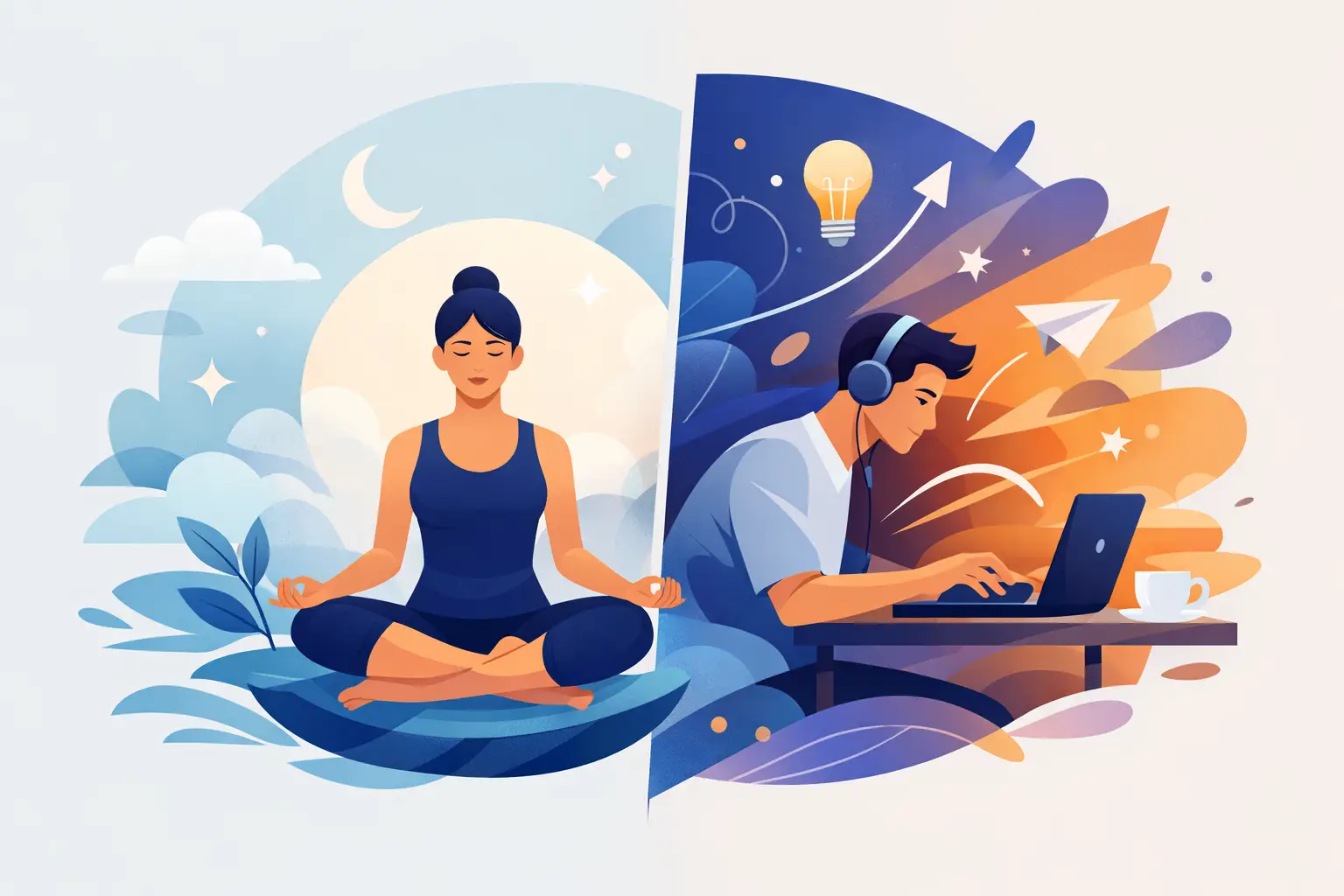
Some days, your mind feels noisy before breakfast. Other days, you sit down to work and everything clicks for two straight hours. That contrast is the heart of meditation vs flow state. They can both improve how you feel and perform, but they are not the same experience, and knowing the difference can save you a lot of trial and error.
For high-performers, this matters because the goal usually is not just to feel calmer. It is to think clearly, work deeply, make better decisions, and finish the day with energy still intact. Meditation can help regulate your internal state. Flow state can help you channel that state into output. When people confuse the two, they often expect the wrong result from the wrong practice.
Meditation vs flow state: the real difference
Meditation is a deliberate practice. You set aside time, direct attention in a specific way, and train the mind to become more aware, less reactive, or more settled. Depending on the style, you might focus on the breath, bodily sensations, a mantra, or open awareness itself. The point is not necessarily productivity. Often, the point is presence.
Flow state is different. Flow happens when your attention becomes fully absorbed in an activity. You are not practicing awareness for its own sake. You are engaged in doing something. Writing, coding, designing, solving, speaking, training, and even strategic planning can trigger it. Time compresses, distractions fade, and the work feels almost frictionless.
A simple way to think about it is this: meditation trains your mind. Flow uses your mind at a very high level.
That does not make flow better. It makes it more task-dependent. Meditation can happen in stillness. Flow almost always needs meaningful action.
Where meditation and flow state overlap
The reason people blur meditation vs flow state is that both can feel deeply immersive. In both states, mental chatter tends to quiet down. Your attention narrows. Stress can drop. You may feel more connected to what you are doing instead of being pulled in six directions at once.
There is also some practical crossover. Meditation can improve the mental conditions that make flow more likely. If your usual baseline is scattered attention, constant internal commentary, and low frustration tolerance, entering flow becomes harder. A meditation habit can help reduce that friction over time.
But overlap does not mean sameness. In meditation, you notice thoughts and return attention. In flow, you often stop noticing yourself altogether because you are fully immersed in the task. Meditation increases awareness of the present moment. Flow can make self-awareness temporarily recede.
That distinction matters, especially if you are trying to solve a specific problem like burnout, poor focus, or brain fog.
What meditation is best for
Meditation tends to be most useful when your nervous system is overstimulated or your mind feels chronically crowded. If you are mentally tired before the workday even begins, meditation can create space. It can help you respond instead of react, especially when stress has been driving your decisions.
It is also valuable if your goal is emotional regulation. Maybe your attention is not just distracted, but hijacked by worry, irritability, or overstimulation. In that case, meditation is not a luxury. It is a reset.
The trade-off is that meditation does not always translate into immediate high-performance output. You may finish a 20-minute session feeling calmer, yet not instantly ready to produce your best strategic work. That is not failure. It just means calm and flow are related, but not interchangeable.
For some people, traditional meditation also feels like one more discipline to maintain. If you already have a full calendar, sitting quietly for a long session can feel difficult to sustain, even when you know it is good for you.
What flow state is best for
Flow shines when you need deep focus and meaningful momentum. It is especially useful for cognitively demanding work that benefits from sustained concentration, like creative production, problem-solving, learning, and decision-making.
When you are in flow, effort often feels lighter even though performance is high. That is why so many entrepreneurs, executives, writers, and creators chase it. Not because it feels mystical, but because it is efficient. Work that usually takes three distracted hours may take one focused hour instead.
The catch is that flow is less controllable than most people want it to be. You cannot force it just by deciding to focus harder. Flow tends to emerge when several conditions line up: clear goals, the right level of challenge, minimal interruption, and enough mental energy to stay engaged.
That is also why flow can feel harder to access in your forties and fifties if stress, poor sleep, digital overload, and mental fatigue have been quietly accumulating. The capacity is still there. But the runway into flow often gets blocked by brain fog and overstimulation.
Which one helps more with brain fog?
If the issue is pure mental clutter, meditation may help first. It can slow the internal noise and help your system downshift. But if the issue is sluggish focus, inconsistent attention, and difficulty getting traction on important work, flow is often the more relevant target.
That is an important nuance. A lot of high-achievers do not actually need more passivity. They need a reliable way to transition from scattered to sharp. They want to feel calm, yes, but they also want to think faster, stay with the task, and stop burning energy on constant task-switching.
This is where many people start looking for tools that bridge the gap between relaxation and performance. Something simpler than a long mindfulness routine, but more targeted than background music.
If you are looking for a simple, science-backed way to enter deep focus and reduce mental fog, The FlowWave Audio https://flowwave-neuroflowlabs.lovable.app/ has helped thousands achieve exactly that. It is designed as a 15-minute daily listening experience that supports deep focus, sharper memory, reduced mental fatigue, and easier access to flow using a precise sequence of brainwave frequencies. For people who want better cognitive performance without pills or a complicated routine, it fits naturally into a busy day.
Meditation vs flow state for performance
If your main goal is long-term self-regulation, meditation deserves a place in the conversation. It can improve patience, awareness, and resilience over time. Those benefits compound quietly.
If your main goal is better output today, flow state often feels more directly useful. It supports execution. It helps you turn mental clarity into actual work.
Still, this is not an either-or decision for everyone. For some, meditation is the foundation and flow is the payoff. A calmer nervous system creates better conditions for immersion. For others, especially those who resist formal meditation, a more performance-oriented tool may be the better entry point because they can feel the result faster.
That depends on temperament. Some people genuinely benefit from stillness practices. Others need an active route into focus. There is no virtue in forcing a method that does not fit your life.
How to choose what fits you now
A useful question is not, Which one is superior? It is, What is your mind missing most right now?
If you feel edgy, overstimulated, emotionally reactive, or unable to slow your thoughts, meditation may be the better first move. It can help restore a sense of steadiness.
If you feel dull, distracted, mentally fatigued, or unable to lock into important work, flow should probably be the target. In that case, practices and tools that prime concentration may serve you better than asking yourself to sit still and observe your breath when your real frustration is poor output.
And if you feel both wired and tired, which is common, you may need a middle path. Something that calms the noise while also preparing the brain for performance.
The better question than meditation vs flow state
Most people do not actually want meditation or flow as abstract concepts. They want to feel like themselves again. Clearer. Calmer. More capable. Less fragmented.
That is why the meditation vs flow state debate can miss the point. The real objective is not to win an argument about mental states. It is to create a repeatable way to think well, work well, and protect your energy.
For some, that starts with meditation. For others, it starts with learning how to access flow more consistently. What matters is choosing the tool that matches your current bottleneck, not the one that sounds most virtuous.
Your mind does not need more pressure. It needs the right conditions. When you give it those conditions, focus stops feeling forced and starts feeling natural again.
Leave a Reply