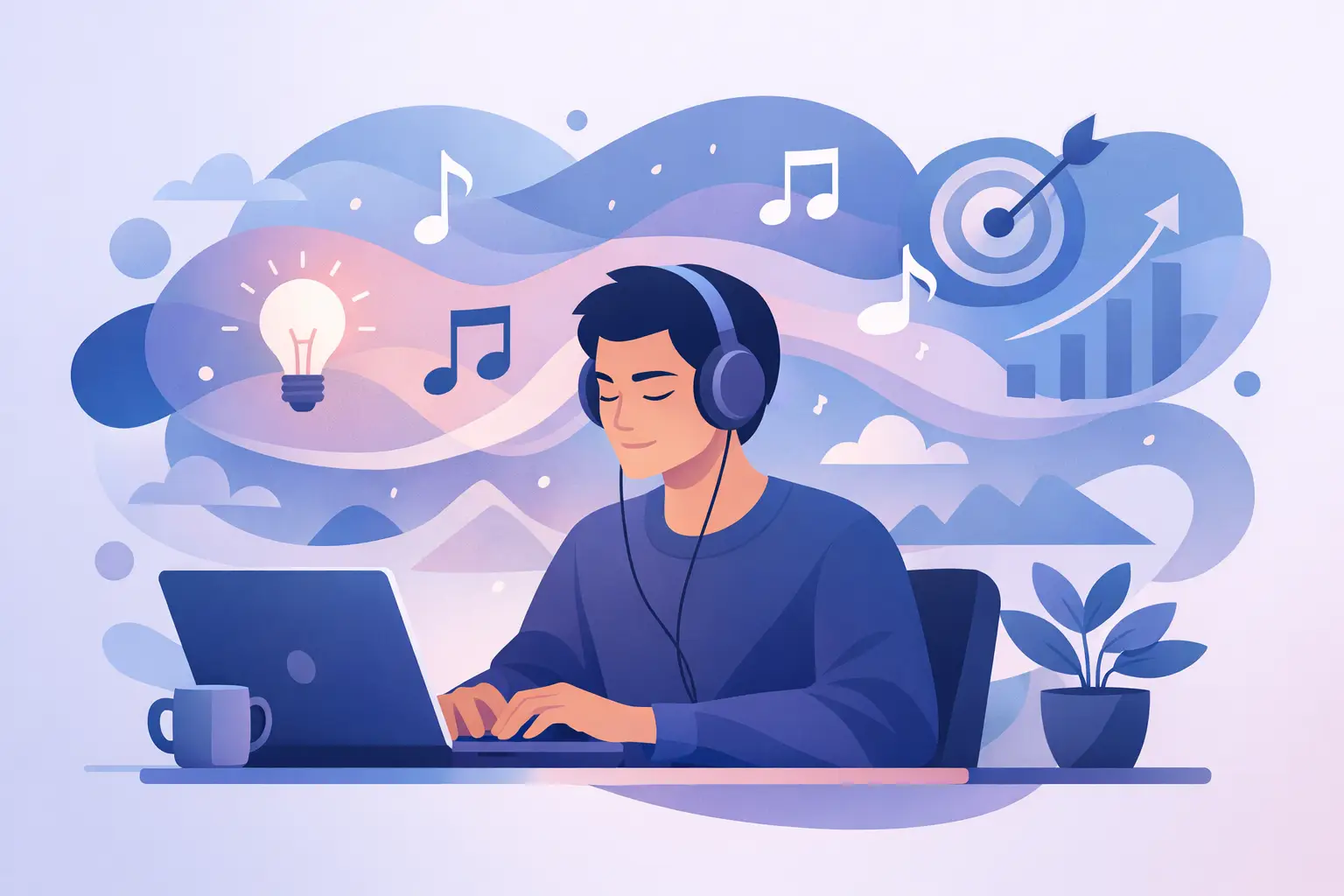
You can feel the difference within minutes. One playlist leaves you restless, skipping tracks and checking your phone. Another seems to quiet the noise in your head, steady your attention, and make the next hour of work feel almost frictionless. That is why choosing the right music to get in flow matters more than most people realize.
For ambitious professionals, creatives, and founders, flow is not a luxury. It is the state where good thinking gets done. The challenge is that modern work conditions are almost perfectly designed to break it. Notifications, context switching, low-grade stress, and mental fatigue all pull your brain toward shallow attention. The right audio can help counter that, but only if it matches the task, your nervous system, and the way your brain responds to sound.
What music to get in flow actually does
Flow is often described as full absorption in a task, but it is also a shift in mental conditions. Your mind becomes alert without feeling tense. Time compresses. Distraction fades into the background. Music can support that state by shaping arousal, mood, and cognitive load.
That last point matters. Not all pleasant music helps you focus. Some tracks are emotionally engaging in a way that pulls attention toward the music itself. Others are too repetitive or too sparse, which can leave your brain under-stimulated and wandering. The best focus audio tends to create just enough structure to anchor attention without demanding it.
This is why people often report better work sessions with instrumental soundscapes, ambient electronic textures, minimalist piano, or carefully engineered sound design. Lyrics, dramatic shifts, and familiar singalong songs can work against deep concentration, especially for writing, strategic thinking, or anything language-heavy.
The best kinds of music to get in flow
There is no single perfect genre because the ideal sound depends on what kind of work you are doing. Still, certain patterns show up consistently.
Ambient music works well when you need long stretches of calm concentration. It fills silence without creating cognitive clutter. It is especially useful for reading, planning, coding, and administrative work where steady attention matters more than emotional intensity.
Electronic downtempo or low-key lo-fi can be effective when you need a bit more forward momentum. The subtle rhythm gives your brain something to synchronize with, which can make it easier to maintain pace during deep work. This often suits designers, editors, and entrepreneurs moving through execution-heavy tasks.
Classical or neo-classical can help if you respond well to melodic structure but get distracted by modern production. Piano, strings, and slower chamber pieces can create a polished mental atmosphere. The trade-off is that highly dynamic compositions may pull you out of focus if they become too dramatic.
Nature-based soundscapes, like rainfall or soft water textures, can be surprisingly useful for people whose brains resist traditional music while working. These sounds can soften external distractions and lower mental tension without adding much processing demand.
Then there is a category beyond ordinary playlists: audio designed specifically to support cognitive states. This is where people start exploring brainwave entrainment and frequency-based sound design. Unlike generic background music, this kind of audio is created with a more targeted purpose – supporting focus, mental clarity, and smoother access to flow.
Why lyrics often break flow
If your work involves words, lyrics are usually the first thing to remove. Your language network does not fully ignore a voice, even when you try. Part of your attention gets pulled toward decoding meaning, anticipating phrases, or emotionally reacting to the song.
That does not mean lyrical music never works. For repetitive physical tasks or familiar routine work, it can be motivating. But for high-value cognitive work, instrumental audio tends to be the safer choice. If you have ever found yourself replaying the same paragraph three times while a favorite song played in the background, you have already felt this effect.
Tempo, repetition, and the sweet spot for focus
A common mistake is assuming more energy equals more focus. Fast, intense music can feel motivating at first, but it often pushes the nervous system into a state that is better for urgency than depth. You may move quickly, but not always thoughtfully.
For most people, the sweet spot sits somewhere in the middle. A steady rhythm, moderate tempo, and minimal surprise tend to support longer attention spans. Repetition helps too, because familiar patterns reduce novelty. Your brain stops tracking the music closely and starts using it as a stable backdrop.
This is one reason the same track or soundscape can outperform a shuffled playlist. Constant changes between songs can act like mini interruptions. Even if each song is good, the transitions create friction.
Science-backed audio vs. generic background music
There is a big difference between music that sounds relaxing and audio that is designed to influence mental state more intentionally. Brainwave entrainment is based on the idea that rhythmic auditory stimulation can encourage the brain to synchronize with certain frequencies associated with specific states, such as relaxed focus or heightened alertness.
For people dealing with brain fog, mental fatigue, or inconsistent concentration, this approach can feel more reliable than hunting for the perfect playlist every day. It is less about musical taste and more about function.
That is why some high-performers prefer structured listening protocols over standard productivity playlists. If your goal is to restore sharp focus quickly with minimal effort, a purpose-built audio track can be more practical than trial and error. The FlowWave Audio is one example, using a 15-minute listening experience built around a precise progression from Alpha to Gamma 40 Hz frequencies with 432 Hz tones to support deep focus, clarity, and effortless flow. Readers who want a more targeted solution can explore The Flow Wave Audio ‘Unlock Your Deep Flow’ at https://flowwave-neuroflowlabs.lovable.app/.
How to choose the right flow music for your task
The best approach is not to ask, what is the best music overall? Ask, what kind of audio best supports this specific type of work?
For writing, strategy, studying, and analysis, go simpler than you think you need. Low-distraction instrumental audio usually wins. For creative ideation, a little more texture or emotional color can help, as long as it does not steal attention. For repetitive tasks, you can often tolerate stronger rhythm and slightly more stimulation.
It also depends on your starting state. If you are anxious and overstimulated, calming audio may help you settle into focus. If you are tired and foggy, you may need something a little brighter and more activating. The right sound does not just match the task. It matches your current brain state.
A simple way to test music to get in flow
Treat your audio like a performance tool, not entertainment. Pick one type of sound and use it for the same kind of work for three days in a row. Notice how quickly you settle, how often you get distracted, and how mentally drained you feel after.
Then compare it with a second option. Keep everything else as consistent as possible – same task type, similar time of day, same duration. Most people can identify useful patterns fast when they stop changing variables every session.
One overlooked sign of good focus audio is not just productivity during the session, but recovery afterward. If you finish a work block feeling clear rather than depleted, your audio choice is probably supporting your nervous system instead of forcing it.
What to avoid when building a flow ritual
Too much variety is usually the problem. A new playlist every day may feel fresh, but it makes it harder for your brain to associate a specific sound with a specific mode of work. Consistency creates a conditioning effect. Over time, the right audio becomes a cue that tells your mind it is time to focus.
Volume matters too. If the sound dominates the room, it becomes the main event. Flow music should shape the environment, not compete with the task.
And if you are already mentally exhausted, do not expect music alone to carry you. Audio can support focus, but it cannot fully override sleep debt, chronic stress, or nonstop interruptions. Sometimes the smartest move is to pair better audio with a shorter, protected work block and a cleaner environment.
The goal is not to create a perfect aesthetic. It is to make deep focus easier to access on demand. When the right sound meets the right task at the right moment, work feels lighter, cleaner, and far less forced. That is the real value of music to get in flow – not more noise, but less internal resistance.
Leave a Reply