Tag: mental clarity

  • Meditation vs Flow State: What Fits You?

    Meditation vs Flow State: What Fits You?

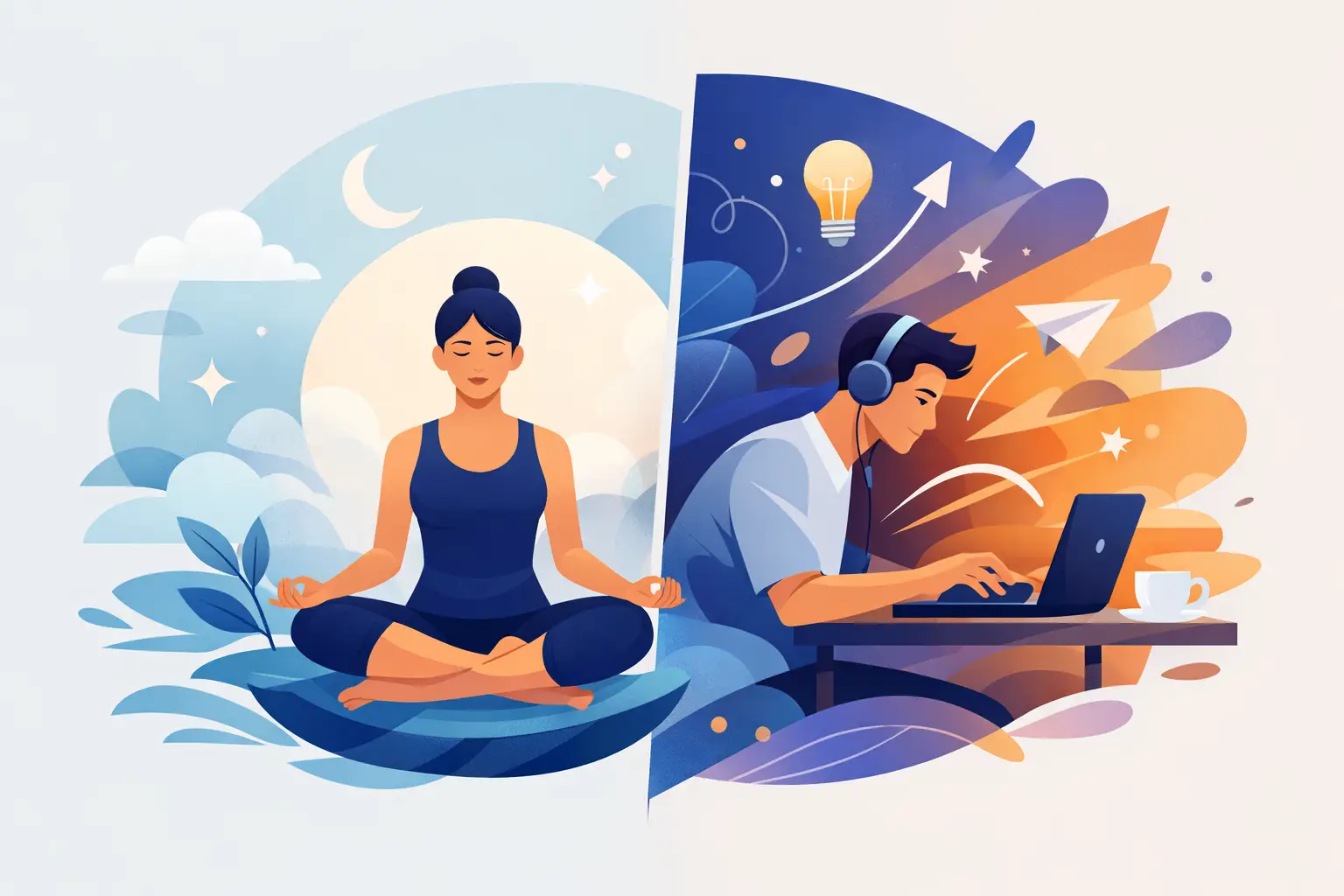
    Some days, your mind feels noisy before breakfast. Other days, you sit down to work and everything clicks for two straight hours. That contrast is the heart of meditation vs flow state. They can both improve how you feel and perform, but they are not the same experience, and knowing the difference can save you a lot of trial and error.

    For high-performers, this matters because the goal usually is not just to feel calmer. It is to think clearly, work deeply, make better decisions, and finish the day with energy still intact. Meditation can help regulate your internal state. Flow state can help you channel that state into output. When people confuse the two, they often expect the wrong result from the wrong practice.

    Meditation vs flow state: the real difference

    Meditation is a deliberate practice. You set aside time, direct attention in a specific way, and train the mind to become more aware, less reactive, or more settled. Depending on the style, you might focus on the breath, bodily sensations, a mantra, or open awareness itself. The point is not necessarily productivity. Often, the point is presence.

    Flow state is different. Flow happens when your attention becomes fully absorbed in an activity. You are not practicing awareness for its own sake. You are engaged in doing something. Writing, coding, designing, solving, speaking, training, and even strategic planning can trigger it. Time compresses, distractions fade, and the work feels almost frictionless.

    A simple way to think about it is this: meditation trains your mind. Flow uses your mind at a very high level.

    That does not make flow better. It makes it more task-dependent. Meditation can happen in stillness. Flow almost always needs meaningful action.

    Where meditation and flow state overlap

    The reason people blur meditation vs flow state is that both can feel deeply immersive. In both states, mental chatter tends to quiet down. Your attention narrows. Stress can drop. You may feel more connected to what you are doing instead of being pulled in six directions at once.

    There is also some practical crossover. Meditation can improve the mental conditions that make flow more likely. If your usual baseline is scattered attention, constant internal commentary, and low frustration tolerance, entering flow becomes harder. A meditation habit can help reduce that friction over time.

    But overlap does not mean sameness. In meditation, you notice thoughts and return attention. In flow, you often stop noticing yourself altogether because you are fully immersed in the task. Meditation increases awareness of the present moment. Flow can make self-awareness temporarily recede.

    That distinction matters, especially if you are trying to solve a specific problem like burnout, poor focus, or brain fog.

    What meditation is best for

    Meditation tends to be most useful when your nervous system is overstimulated or your mind feels chronically crowded. If you are mentally tired before the workday even begins, meditation can create space. It can help you respond instead of react, especially when stress has been driving your decisions.

    It is also valuable if your goal is emotional regulation. Maybe your attention is not just distracted, but hijacked by worry, irritability, or overstimulation. In that case, meditation is not a luxury. It is a reset.

    The trade-off is that meditation does not always translate into immediate high-performance output. You may finish a 20-minute session feeling calmer, yet not instantly ready to produce your best strategic work. That is not failure. It just means calm and flow are related, but not interchangeable.

    For some people, traditional meditation also feels like one more discipline to maintain. If you already have a full calendar, sitting quietly for a long session can feel difficult to sustain, even when you know it is good for you.

    What flow state is best for

    Flow shines when you need deep focus and meaningful momentum. It is especially useful for cognitively demanding work that benefits from sustained concentration, like creative production, problem-solving, learning, and decision-making.

    When you are in flow, effort often feels lighter even though performance is high. That is why so many entrepreneurs, executives, writers, and creators chase it. Not because it feels mystical, but because it is efficient. Work that usually takes three distracted hours may take one focused hour instead.

    The catch is that flow is less controllable than most people want it to be. You cannot force it just by deciding to focus harder. Flow tends to emerge when several conditions line up: clear goals, the right level of challenge, minimal interruption, and enough mental energy to stay engaged.

    That is also why flow can feel harder to access in your forties and fifties if stress, poor sleep, digital overload, and mental fatigue have been quietly accumulating. The capacity is still there. But the runway into flow often gets blocked by brain fog and overstimulation.

    Which one helps more with brain fog?

    If the issue is pure mental clutter, meditation may help first. It can slow the internal noise and help your system downshift. But if the issue is sluggish focus, inconsistent attention, and difficulty getting traction on important work, flow is often the more relevant target.

    That is an important nuance. A lot of high-achievers do not actually need more passivity. They need a reliable way to transition from scattered to sharp. They want to feel calm, yes, but they also want to think faster, stay with the task, and stop burning energy on constant task-switching.

    This is where many people start looking for tools that bridge the gap between relaxation and performance. Something simpler than a long mindfulness routine, but more targeted than background music.

    If you are looking for a simple, science-backed way to enter deep focus and reduce mental fog, The FlowWave Audio https://flowwave-neuroflowlabs.lovable.app/ has helped thousands achieve exactly that. It is designed as a 15-minute daily listening experience that supports deep focus, sharper memory, reduced mental fatigue, and easier access to flow using a precise sequence of brainwave frequencies. For people who want better cognitive performance without pills or a complicated routine, it fits naturally into a busy day.

    Meditation vs flow state for performance

    If your main goal is long-term self-regulation, meditation deserves a place in the conversation. It can improve patience, awareness, and resilience over time. Those benefits compound quietly.

    If your main goal is better output today, flow state often feels more directly useful. It supports execution. It helps you turn mental clarity into actual work.

    Still, this is not an either-or decision for everyone. For some, meditation is the foundation and flow is the payoff. A calmer nervous system creates better conditions for immersion. For others, especially those who resist formal meditation, a more performance-oriented tool may be the better entry point because they can feel the result faster.

    That depends on temperament. Some people genuinely benefit from stillness practices. Others need an active route into focus. There is no virtue in forcing a method that does not fit your life.

    How to choose what fits you now

    A useful question is not, Which one is superior? It is, What is your mind missing most right now?

    If you feel edgy, overstimulated, emotionally reactive, or unable to slow your thoughts, meditation may be the better first move. It can help restore a sense of steadiness.

    If you feel dull, distracted, mentally fatigued, or unable to lock into important work, flow should probably be the target. In that case, practices and tools that prime concentration may serve you better than asking yourself to sit still and observe your breath when your real frustration is poor output.

    And if you feel both wired and tired, which is common, you may need a middle path. Something that calms the noise while also preparing the brain for performance.

    The better question than meditation vs flow state

    Most people do not actually want meditation or flow as abstract concepts. They want to feel like themselves again. Clearer. Calmer. More capable. Less fragmented.

    That is why the meditation vs flow state debate can miss the point. The real objective is not to win an argument about mental states. It is to create a repeatable way to think well, work well, and protect your energy.

    For some, that starts with meditation. For others, it starts with learning how to access flow more consistently. What matters is choosing the tool that matches your current bottleneck, not the one that sounds most virtuous.

    Your mind does not need more pressure. It needs the right conditions. When you give it those conditions, focus stops feeling forced and starts feeling natural again.

  • The Future of Focus Training

    The Future of Focus Training

    Ten years ago, focus training usually meant willpower, a timer, and another productivity system you hoped would finally stick. For most high-performers, that approach is starting to feel outdated. The future of focus training is less about forcing attention and more about creating the right internal conditions for it – quickly, consistently, and without adding more friction to an already full day.

    That shift matters if you’ve noticed your brain does not respond the way it used to. You may still be driven, capable, and experienced, yet your attention feels more scattered. Context switching takes a bigger toll. Mental fatigue shows up earlier. The old answer was to push harder. The next answer is smarter training.

    What the future of focus training will actually look like

    The biggest change is simple: focus will be treated less like a personality trait and more like a trainable brain state. That may sound subtle, but it changes everything. Instead of assuming concentration depends on discipline alone, newer methods are built around nervous system regulation, cognitive recovery, and environmental design.

    This means the best focus training programs of the next few years will not just ask, “How do I get more done?” They will ask, “What helps the brain enter and sustain a high-performance state with less resistance?” For busy professionals, that is a much better question.

    You can already see this shift happening. Meditation apps introduced more people to mental training, but many users wanted something more targeted. Nootropics promised sharper cognition, but results were inconsistent and often depended on the person. Productivity frameworks helped with structure, yet they rarely solved brain fog. The future is moving toward tools that support focus at the level of brain state, not just behavior.

    Focus training is becoming more biological and less motivational

    Traditional advice often assumes that distraction is a mindset problem. Sometimes it is. But many adults dealing with attention drift are also dealing with overstimulation, poor recovery, sleep debt, chronic stress, or cognitive overload. In those cases, motivation is not the missing piece. Capacity is.

    That is why brain-based approaches are gaining traction. When people can regulate arousal, calm background mental noise, and reach a state of alert steadiness, focus feels less forced. They do not need to fight their own mind for an hour before getting into meaningful work.

    This is where the category gets more interesting. Brainwave entrainment, neurofeedback, and sensory-based protocols are beginning to move from the edges of wellness into more mainstream performance routines. Not because they sound futuristic, but because they reduce effort. And for adults balancing careers, family, and constant digital demands, low-effort tools win.

    The future of focus training will be personalized

    One reason so many focus routines fail is that they assume everyone loses concentration for the same reason. They do not. One person is under-recovered and mentally depleted. Another is overstimulated and anxious. Another has decent energy but poor cognitive endurance. If the cause differs, the solution should too.

    That is where personalization will shape the future of focus training. Over time, the strongest tools in this space will adapt to how your brain performs at different times of day, under different workloads, and in different emotional states. Some people will need calming before focus. Others will need activation. Some will need support for memory encoding. Others will need help sustaining attention over longer sessions.

    The trade-off is that personalization can become complicated fast. More data does not always create better results if the method is too technical to use consistently. That is why the most effective solutions will likely be the ones that feel simple on the surface while being precise behind the scenes.

    Why passive focus tools are becoming more valuable

    There is a reason passive tools are growing in appeal. Most ambitious adults are not looking for another routine to manage. They want results without another layer of decision fatigue.

    That makes short, structured audio protocols especially relevant. Rather than asking you to learn a complex technique, they help create conditions that support concentration directly. This matters for people who have tried meditation but struggled to stay with it, or who want deeper focus without relying on stimulants every afternoon.

    If you’re looking for a simple, science-backed way to enter deep focus and reduce mental fog, The FlowWave Audio has helped thousands achieve exactly that. https://flowwave-neuroflowlabs.lovable.app/

    What makes this kind of tool fit the future so well is not novelty. It is usability. A 15-minute daily protocol is easier to repeat than a complicated stack of supplements, breathwork sessions, journaling prompts, and app-based exercises. Consistency often matters more than intensity.

    The future of focus training and brain health will merge

    For years, focus was framed mainly as a productivity issue. That framing is too narrow now. More people are starting to see attention, memory, and mental clarity as connected to long-term brain health, not just this week’s to-do list.

    That changes how focus training is positioned. It is no longer just about squeezing more output from a tired brain. It is about supporting cognitive resilience over time. For adults in their late thirties, forties, and fifties, that message lands differently. They are not simply trying to perform better tomorrow. They want to stay sharp for the next decade.

    This is one of the most important shifts ahead. Expect focus training to move closer to preventive wellness, where daily cognitive support becomes as normal as exercise, sleep hygiene, and nutrition. The most trusted brands in this space will be the ones that respect both sides of the equation: immediate mental performance and long-term brain support.

    What won’t define the future of focus training

    Not every trend will last. Some tools will overpromise. Some will package basic relaxation as advanced cognition. Some will make the process so data-heavy that people stop using it after a week.

    The future probably does not belong to anything that feels gimmicky, extreme, or exhausting. High-performers do not need more noise. They need methods that feel calm, credible, and effective.

    It also will not belong entirely to one solution. Focus is influenced by sleep, stress, movement, environment, and mental habits. No audio, supplement, or app replaces those foundations. The better question is which tools make it easier to get back into a clear, productive state even when life is busy and imperfect.

    How to think about focus training now

    You do not need to wait for the future to arrive to benefit from this shift. The smartest approach today is to stop treating focus as a moral issue and start treating it as a system.

    If your attention is inconsistent, look at what state your brain is in before you blame your discipline. Are you mentally overloaded? Under-recovered? Stuck in shallow stimulation all day? Do you need a longer routine, or a simpler one you will actually use? Those questions are far more useful than another lecture about trying harder.

    A practical focus system usually includes fewer moving parts than people expect. A protected work block, reduced digital interference, realistic recovery, and one reliable tool that helps your brain settle into concentration can go a long way. The future of focus training is not about doing more. It is about needing less force to do your best work.

    That is why science-backed audio is becoming such a compelling category. When designed well, it can help bridge the gap between how you want to feel and how your brain actually feels at the start of a demanding day. For professionals who want sharper memory, deeper focus, and less mental fatigue without pills or complicated routines, that is a meaningful shift.

    A calmer standard for high performance

    The old image of focus was rigid and tense – white-knuckled concentration, endless coffee, and pushing through mental static. The next version looks calmer. More precise. More sustainable.

    That may be the most promising part of all. The future of focus training is not about turning you into a machine. It is about helping your mind work the way it works best: clear, steady, and fully engaged when it matters most.

    If that future appeals to you, the real opportunity is not to chase every new trend. It is to choose tools and habits that respect your time, support your brain, and make deep focus feel available again.

  • Best Audio for Concentration That Works

    Best Audio for Concentration That Works

    You can feel the difference within minutes. One track makes your brain feel crowded. Another softens the noise, steadies your breathing, and helps you slide into work without forcing it. That is why the search for the best audio for concentration matters more than most people think. When your attention is already fragmented, the wrong sound adds friction. The right sound removes it.

    For high performers, focus is rarely just about willpower. It is about state. If your nervous system is overstimulated, your mind jumps. If you are underpowered, your attention drifts. Audio can help bridge that gap by giving your brain a cleaner environment to work in. But not all focus audio works the same way, and what helps during a deep writing session may not help during admin, studying, or creative problem-solving.

    What makes the best audio for concentration?

    The best concentration audio does not simply cover up distracting sounds. It creates conditions that support sustained attention. That usually means fewer sudden changes, a steady emotional tone, and enough texture to hold the edge of your awareness without pulling you away from the task.

    This is where many playlists fail. Popular music can be energizing, but lyrics compete with verbal processing. Soundtracks can feel cinematic, but dramatic shifts in volume or mood can pull your brain out of the work. Even white noise, while useful in some settings, can feel flat or fatiguing after a while.

    The best audio for concentration tends to do three things well. It lowers mental clutter, reduces the sense of effort, and helps you stay in one cognitive lane. That is a different goal than relaxation. You do not necessarily want sleepy. You want calm, alert, and absorbed.

    The main types of concentration audio

    Binaural beats and brainwave-based audio

    This category gets the most attention, and for good reason. Binaural beats and other brainwave-based tracks are designed to influence mental state through carefully structured frequencies. Some listeners report that these tracks help them settle faster, especially when their mind feels noisy or overstimulated.

    The upside is that this kind of audio can feel purpose-built for focus rather than just pleasant in the background. The trade-off is that it is not universally effective. Some people find it deeply regulating. Others feel nothing, or they find certain frequencies irritating over time. Headphones are often recommended, which may not suit every work setup.

    For people who struggle to transition into deep work, this type of engineered audio can be especially helpful because it gives the brain a repeatable cue. Over time, that cue can become part of a ritual. Your body starts to recognize that it is time to narrow attention.

    Nature sounds and ambient soundscapes

    Rain, ocean waves, forest soundscapes, and low ambient textures remain popular because they are easy to tolerate for long stretches. They can soften harsh environments without demanding attention. If your workday is filled with small interruptions, nature audio often creates a more forgiving background than silence.

    This works best when the recording is consistent and uncluttered. Gentle rainfall can be excellent. A nature track filled with birds, insects, and changing environmental details can become its own distraction. The line is subtle but real.

    Nature audio is often a strong choice for people who want concentration support without anything that feels too clinical or intense. It is less about pushing performance and more about creating spaciousness.

    White noise, pink noise, and brown noise

    Noise-based audio can be surprisingly effective, especially if your environment is unpredictable. Offices, apartments, shared homes, and coffee shops all create attention residue. A stable layer of noise helps block those spikes before your brain has to react to them.

    White noise is sharper and brighter. Pink noise is smoother and often easier to listen to for longer periods. Brown noise is deeper and fuller, which many people describe as grounding. If white noise feels harsh, brown noise may be the better fit.

    The drawback is that noise alone does not always help you enter a more focused state. It can protect attention, but it may not actively guide it. Think of it as insulation rather than direction.

    Instrumental music and low-distraction scores

    For some tasks, instrumental audio works beautifully. It adds energy, motion, and emotional lift without the interference of lyrics. This can be useful for repetitive work, ideation, or creative sessions where a bit of momentum helps.

    Still, this is the category most likely to backfire. Melodies stick. Rhythms pull. If the music is too compelling, your attention follows it instead of the task. If your work is language-heavy, even soft instrumental tracks can compete with reading, writing, or strategic thinking.

    If you use music for concentration, choose tracks with minimal dynamic changes and no recognizable hooks. The less your brain wants to follow the song, the better.

    How to choose the best audio for concentration for your brain

    The honest answer is that it depends on what is disrupting your focus in the first place. If external noise is the problem, masking sounds like brown noise or rain may be enough. If mental overactivity is the problem, a more engineered audio experience may work better because it helps regulate your state, not just your environment.

    It also depends on the kind of work you are doing. Deep analytical work usually benefits from more neutral audio. Creative flow can tolerate a little more movement. Admin tasks may even improve with slightly more stimulating sound because the work itself does not naturally pull you in.

    The best approach is to stop treating concentration audio as one category. Match the audio to the moment. Use one type for entering deep work, another for staying there, and another for noisy environments. That shift alone can make your focus practice feel more precise and less frustrating.

    Why some audio helps you focus faster

    The most useful audio does more than sit in the background. It becomes a state trigger. When you hear the same track or style consistently before focused work, your brain starts associating that sound with a specific mode of attention. That matters because focus is not just a decision. It is a pattern.

    This is one reason guided or engineered audio can be so effective for busy professionals. It reduces the friction of switching modes. Instead of wrestling your way out of stress, distraction, or mental fog, you create a familiar pathway into clarity. Less pushing. More entering.

    For readers who want a more intentional solution, The Flow Wave Audio “Unlock Your Deep Flow” at https://flowwave-neuroflowlabs.lovable.app/ is designed around that exact shift. It is built as a simple daily ritual to calm mental noise, restore sharp focus, and help you enter a deeper working state without adding another complicated system to your day.

    Common mistakes when using concentration audio

    One mistake is constantly switching tracks. If you are trying a new sound every ten minutes, you are training novelty, not focus. Another is choosing audio based on what feels interesting instead of what feels stabilizing. Concentration audio should support the work, not become part of the entertainment.

    Volume also matters more than people realize. Too loud, and the audio becomes a foreground event. Too soft, and it cannot do its job. You want it present enough to shape your attention, but not dominant enough to steal it.

    There is also the issue of expectation. Audio is a support tool, not magic. If you are sleep-deprived, flooded with stress, and checking messages every three minutes, even the best track will have limited impact. But when paired with a clear task and a consistent routine, it can meaningfully improve the quality of your focus.

    The best audio for concentration is the one you can repeat

    A lot of people chase the perfect sound when they should be building a reliable ritual. The ideal audio is not necessarily the most advanced or the most hyped. It is the one that helps you settle quickly, stay steady, and return to it again tomorrow.

    That is especially true if your goal is not just to get through one hard afternoon, but to create a sustainable pattern of deep work. Focus improves when the entry point becomes familiar. Your brain stops negotiating and starts responding.

    If your attention has felt scattered lately, keep it simple. Choose one style of audio that feels calming but alert. Use it at the same time each day. Give it enough repetition to become a cue, not just a soundtrack. The right sound will not force concentration. It will make concentration feel more available.

  • 15 Minute Focus Ritual That Actually Works

    15 Minute Focus Ritual That Actually Works

    Your best work usually does not fail because you lack skill. It slips because your attention gets pulled in ten directions before you ever get momentum. A 15 minute focus ritual creates a cleaner starting point. Instead of forcing concentration through stress, it helps your mind settle, your body downshift, and your attention lock onto what matters.

    That shift is small, but the effect is not. When you stop treating focus like something you have to wrestle into place, deep work becomes more available. Not every day will feel effortless, but the right ritual makes focused work far more repeatable.

    Why a 15 minute focus ritual works

    Most people try to enter deep work too abruptly. They go from email, texts, meetings, tabs, and background stress straight into demanding cognitive work. Then they blame themselves when their mind keeps skimming the surface.

    The problem is not always discipline. Often, it is state.

    Focus is easier when your nervous system is not overloaded. If your mind is noisy, your body is tense, or your attention is still scattered from the last task, your brain stays in reaction mode. A short ritual gives you a transition. It signals that you are leaving stimulation behind and moving into a more deliberate, concentrated mode.

    That is why 15 minutes is a useful window. It is long enough to interrupt mental momentum from distractions, but short enough to feel realistic on a busy day. You do not need an hour. You need a reliable reset.

    What a good 15 minute focus ritual should do

    A strong ritual is not just a productivity trick. It should calm mental friction while preparing you to perform.

    That means it needs to do three things at once. First, it reduces input. Second, it narrows your attention. Third, it creates a clear entry into the one task that deserves your best energy.

    If your ritual is too complicated, you will avoid it. If it is too passive, it will feel nice but not translate into output. The sweet spot is simple, repeatable, and slightly intentional. You should finish it feeling clearer, steadier, and ready to begin.

    The structure of an effective 15 minute focus ritual

    The exact details can vary, but the rhythm matters. Think of the ritual as a sequence that clears, steadies, and directs.

    Minute 1 to 3: remove friction

    Start by lowering noise. Silence notifications. Close nonessential tabs. Put your phone out of reach, not face down beside you. The goal is not digital perfection. It is reducing the obvious exits your attention will take once the work gets uncomfortable.

    This is also the moment to set your workspace. A glass of water, a notebook, one open document, one visible objective. Small cues matter because your brain reads them as instructions.

    Minute 4 to 8: regulate your state

    Before you ask for high performance, create enough calm for focus to land. This can be a few minutes of slow breathing, stillness, or guided audio designed to settle mental noise without making you sleepy.

    This step is where many high achievers see the biggest shift. They are used to pushing harder when they feel distracted. But distraction often softens when the body feels safer and the mind is less overstimulated. Calm is not the opposite of performance. Very often, it is the doorway to it.

    For some people, audio works especially well here because it gives the mind something structured to follow. The Flow Wave Audio fits naturally into this kind of ritual because it is built as a short daily practice that supports calm and concentration at the same time.

    Minute 9 to 12: define the target

    Once you feel more settled, decide what this session is for. Not your entire day. Not your whole career. Just the next block of meaningful work.

    Write one sentence that answers this question: what would make the next work session count?

    Be specific. Finish the pitch draft. Outline the presentation. Solve the first section of the analysis. Vague goals produce vague attention. Clear targets create cognitive traction.

    Minute 13 to 15: begin before you feel fully ready

    The final step is not more preparation. It is entry.

    Open the file. Write the first line. Sketch the first idea. Review the first paragraph. The ritual should end with movement, not contemplation. Otherwise, you can end up feeling centered but still stalled.

    This matters because focus strengthens after you begin, not before. Starting while your mind is clear helps momentum take over.

    Common mistakes that make the ritual fail

    A 15 minute focus ritual can be powerful, but only if it stays clean.

    One common mistake is turning it into another self-improvement project. You do not need six habit trackers, a perfect morning routine, and the ideal playlist. If your ritual feels like a performance, it creates pressure instead of relief.

    Another mistake is using the ritual to avoid work. There is a difference between preparing to focus and circling focus. If you keep adjusting your environment, rewriting your goals, or searching for the perfect mood, the ritual becomes procrastination in better branding.

    There is also the issue of timing. Some people benefit most from using the ritual first thing in the morning, when mental bandwidth is highest. Others need it in the early afternoon, when energy dips and attention fragments. It depends on your schedule, your workload, and how your mind tends to drift. The best ritual is the one you will actually use before your most important work.

    How to make the ritual stick

    Consistency matters more than intensity. A ritual works best when it becomes familiar enough that your mind starts recognizing the pattern.

    Try attaching it to an existing work cue. That might be after dropping the kids off, before your first creative block, or right after lunch. Repetition builds association. Over time, the ritual itself becomes a signal that it is time to focus.

    Keep the components stable for at least a week before changing them. If you are always tweaking the system, you never give your brain a chance to trust it. Familiarity reduces resistance.

    It also helps to measure the right outcome. Do not ask whether the ritual made you feel superhuman. Ask whether it helped you start faster, stay with the task longer, or feel less mentally scattered. Those are real wins. They add up.

    When a 15 minute focus ritual helps most

    This kind of practice is especially useful when your attention feels expensive. Maybe you are carrying low-grade stress, bouncing between roles, or recovering from a stretch of shallow work. Maybe you are capable of deep focus, but you cannot access it on demand anymore.

    A ritual gives you a bridge back.

    It is also useful for people who are mentally tired but still need to perform. Not in a push-through-the-pain way. In a more sustainable way. A focused state built on regulation tends to feel cleaner than one built on adrenaline.

    That said, there are limits. If you are severely sleep deprived, chronically overloaded, or trying to do three people’s jobs, no ritual will erase that reality. It can help you create better work conditions inside a hard season, but it is not a substitute for recovery, boundaries, or realistic expectations.

    The real value of a short ritual If

    you want the perfect 15 minute ritual for productivity and flow state click here: https://flowwave-neuroflowlabs.lovable.app/  The deeper benefit is not just productivity. It is self-trust.

    When you know you have a simple way to steady yourself and begin, work feels less chaotic. You stop waiting for the perfect mood. You stop assuming scattered days are lost days. You build a repeatable way to come back to center and move forward.

    That is what makes a 15 minute focus ritual worth protecting. It asks very little, but it can change the quality of the next hour, the next project, and sometimes your whole relationship with work.

    If your mind has felt too busy to do what you know you are capable of, start smaller than ambition usually tells you to. Give yourself fifteen quiet, intentional minutes, and let that be enough to begin.

  • How to Enter Flow State More Consistently with The Flow Wave Audio

    How to Enter Flow State More Consistently with The Flow Wave Audio

    Some days, your brain feels like a browser with 27 tabs open. You sit down to work, but your attention keeps slipping – to messages, half-finished thoughts, low-grade stress, and the pressure to perform. If you want to know how to enter flow state, the answer usually is not more force. It is less friction.

    Flow is not a rare peak reserved for elite athletes, artists, or founders on perfect mornings. It is a real, trainable condition where attention narrows, mental noise softens, and the work starts carrying you forward. You feel clear, absorbed, and effective at the same time. That is why flow matters so much for modern work. It is one of the few states that improves performance without making you feel more strained.

    What flow state actually feels like

    Flow is often described as deep focus, but that undersells it. Focus can still feel tense. Flow feels smoother. You are fully engaged, but not gripping. Time changes. Self-consciousness fades. The task becomes easier to stay with because your mind is no longer splitting its energy between the work and everything else.

    There is also a physical side to it. Your breathing tends to settle. Your nervous system feels more regulated. You are alert, but not wired. This is one reason so many people struggle to access flow when they are stressed. A distracted mind is part of the problem, but an overstimulated body is often underneath it.

    That is the key shift. If you have been treating flow like a motivation problem, you may be missing the real issue. For many high performers, the barrier is not laziness. It is cognitive clutter and nervous-system overload.

    How to enter flow state without forcing it

    The fastest way to make flow more available is to stop waiting for it to appear spontaneously. Build the conditions that make it more likely.

    Start with a task that has a clear edge. Flow does not happen well in vague work. “Work on my business” is too broad. “Draft the opening section of the proposal” gives your mind something it can lock onto. Specificity lowers resistance because the brain does not have to keep deciding what to do next.

    The task also needs the right level of challenge. Too easy, and your mind wanders. Too hard, and you tense up or avoid it. Flow tends to appear when the task stretches you, but does not flood you. That range is personal. It changes based on sleep, stress, and how mentally taxed you already are. On low-energy days, entering flow may require a smaller target.

    Your environment matters more than most people want to admit. If your phone is visible, your inbox is open, and five tabs are pulling at your attention, you are not in a flow-friendly setup. You are in a tug-of-war. Reduce decision points. Clear the visual field. Remove alerts. Make it easier to stay than to switch.

    Then create a transition ritual. This is where consistency starts. Flow is easier to access when your brain recognizes a repeatable cue that says, it is time to narrow attention now. That cue might be the same desk, the same headphones, the same breathing pattern, or the same 15-minute audio session before deep work. The ritual matters because it shortens the distance between scattered and focused.

    Why calm helps performance

    A lot of advice about productivity is built on stimulation. More urgency. More pressure. More push. That can work for short bursts, but it often backfires when the goal is sustained concentration.

    Flow responds better to calm intensity. That means your mind is awake, but not noisy. Your body is settled, but not sleepy. You feel engaged without feeling chased. This is where people often get stuck. They want high output, so they keep using high stress to generate it. The result is inconsistency. Some days they can power through. Other days they burn out before they begin.

    Learning how to enter flow state often comes down to nervous-system regulation as much as mindset. When the body reads the moment as safe enough to focus, attention stabilizes. You stop scanning for everything else. More energy becomes available for the task in front of you.

    That is why short practices can be so effective. You do not always need an hour of meditation or a perfect morning routine. Sometimes you need a fast reset that lowers internal static and helps your brain shift gears. For people with demanding schedules, that simplicity matters.

    A practical flow ritual you can use today https://flowwave-neuroflowlabs.lovable.app/

    If you want a repeatable approach, keep it minimal. Complex systems often create their own resistance.

    First, choose one meaningful task. Not three. Not your whole afternoon. One task that matters and can be advanced in the next 30 to 90 minutes. Give it a visible finish line so your brain knows what success looks like.

    Next, reduce external friction. Put the phone out of reach. Close what you are not using. Keep only the materials needed for the task in front of you. This is simple, but it changes the quality of attention almost immediately.

    Then spend a few minutes settling your state before you begin. Slow breathing works. So does a short audio-based focus ritual designed to calm mental noise while sharpening attention. For many people, this is the missing piece. They try to think their way into flow when what they actually need is a cleaner internal state. A revolutionary tool based on latest studies on gamma frequencies as The Flow Wave Audio can fit well here because it gives you a fast, repeatable entry point instead of asking you to manufacture focus from scratch.

    Once you begin, protect the first ten minutes fiercely. This is the fragile window where the urge to switch tasks is strongest. Do not evaluate your performance too early. Do not ask whether you feel fully locked in yet. Stay with the task long enough for momentum to build. Flow often arrives after commitment, not before.

    Finally, stop before you are completely fried. This sounds counterintuitive, but leaving a little energy in the tank makes it easier to return. If every deep work session ends in exhaustion, your brain starts associating focus with depletion. A better pattern is intensity with recovery.

    What gets in the way of flow

    Multitasking is the obvious one, but internal pressure is just as disruptive. If you sit down believing this session has to be brilliant, important, or proof of your capability, you create friction before the work even starts. Flow likes absorption, not self-surveillance.

    Poor recovery also matters. If your sleep is off, your stress load is high, or your brain has been in constant input mode all day, flow will be harder to access. That does not mean the day is lost. It means your entry ramp may need to be gentler. Lower the challenge slightly. Extend the transition ritual. Aim for progress, not perfection.

    There is also the problem of inconsistency. Many people only try to access flow when the stakes are high. That is like practicing a skill only during the championship game. Flow becomes more reliable when you rehearse entering it under normal conditions. A short daily practice works better than occasional heroic effort.

    Make flow a pattern, not a lucky break

    The people who seem to access flow on command usually are not relying on mood. They have a structure. They know what kind of work invites flow for them, what time of day they are most cognitively sharp, and what cues help them transition quickly.

    That level of awareness does not have to become obsessive. In fact, keeping it simple is usually better. Notice when your best sessions happen. Notice what was present before them. Was the task clear? Was your body calm? Did you remove distractions? Did you use a ritual that signaled focus? Those patterns tell you more than generic productivity advice ever will.

    If you are serious about learning how to enter flow state, think less about chasing a magical feeling and more about building reliable conditions. Clarity, challenge, calm, and repetition beat intensity alone.

    The goal is not to become a machine. It is to make deep focus feel easier to access in a noisy world. When your mind is clear and your energy is steady, good work stops feeling so hard to begin. And that shift, practiced daily, can change far more than a single work session.

  • A Daily Ritual for Focus That Actually Sticks

    A Daily Ritual for Focus That Actually Sticks

    Your calendar is full by 9 a.m., your inbox is already loud, and somehow the most important work still gets pushed into a shrinking window of mental energy. That is exactly why a daily ritual for focus matters. Not as another productivity rule to follow, but as a simple way to train your brain to shift into clear, steady concentration before distractions take over.

    For most high-performers, the real problem is not motivation. It is cognitive friction. You sit down to work, but your mind is still carrying yesterday’s decisions, this morning’s notifications, and the low-grade stress that makes everything feel heavier than it should. A good ritual reduces that transition cost. It tells your brain, with consistency, that it is time to concentrate.

    Why a daily ritual for focus works

    Focus is rarely about willpower alone. It is usually the result of cues, state, and environment lining up at the right time. When your brain knows what happens before deep work starts, it wastes less energy resisting the shift.

    That is why rituals outperform random bursts of discipline. A ritual is repeatable. It creates a predictable pattern your nervous system can recognize. Over time, even small actions can become powerful triggers. The same cup of coffee, the same desk reset, the same 15-minute audio session, the same first task. Your brain begins to associate that sequence with calm attention instead of scattered effort.

    There is also a practical reason this works so well for adults balancing demanding jobs, families, and constant inputs. Rituals lower decision fatigue. You stop asking, What should I do to focus today? You simply begin.

    The biggest mistake people make

    Most people design a focus routine for their ideal life, not their real one. They build something that sounds impressive but falls apart by Wednesday.

    A 90-minute morning routine might work if your schedule is wide open. For a busy professional or entrepreneur, it can become one more thing to fail at. The better approach is to create a ritual that is short enough to repeat, but strong enough to change your mental state.

    That usually means keeping it simple, consistent, and low-friction.

    What a good daily ritual for focus includes

    A useful ritual does three jobs. First, it removes noise. Second, it signals the brain to settle. Third, it creates momentum into meaningful work.

    You do not need a complicated stack of supplements, apps, journals, and timers. In fact, more tools can become more distraction. What matters is whether your ritual helps you feel mentally clear, emotionally steady, and ready to direct attention where it counts.

    For most people, the strongest rituals include a physical cue, a mental cue, and a defined starting point. The physical cue might be clearing your workspace or putting your phone out of reach. The mental cue might be a short breathing practice or focus audio. The defined starting point is the first task you begin immediately after the ritual ends.

    A simple 15-minute focus ritual

    If you want something realistic, start here.

    Begin by removing the obvious distractions. Put your phone on silent and out of sight. Close extra browser tabs. Clear your desk just enough that your eyes are not constantly scanning unfinished business. This takes two minutes, not twenty.

    Next, settle your nervous system. When the mind is overstimulated, focus feels forced. A brief reset can help shift you out of reactive mode. Some people use slow breathing. Others use a short walk. For many, audio works better because it reduces effort. Instead of trying to meditate perfectly, you simply listen and let your brain follow the pattern.

    This is where a targeted tool can make a real difference. The FlowWave Audio is designed as a 15-minute daily listening experience for deep focus, reduced mental fatigue, and easier access to flow states. If you want a low-effort way to support your ritual, you can explore The Flow Wave Audio “Unlock Your Deep Flow” at https://flowwave-neuroflowlabs.lovable.app/.

    After that, move directly into one clearly chosen task. Not five priorities. One. The ritual should end in action, not more preparation. Open the document, start the analysis, outline the proposal, write the first paragraph. The goal is to make the transition from ritual to work feel almost automatic.

    Morning is ideal, but not mandatory

    A lot of focus advice assumes everyone does their best thinking at sunrise. That is not always true.

    Morning is often the easiest place to anchor a daily ritual for focus because fewer demands have piled up yet. Your attention is less fragmented, and there is less emotional residue from the day. But if your best cognitive window happens at 10 a.m. or even later in the afternoon, use that instead.

    The key is consistency, not perfection. Your ritual should happen before your most valuable work block, whenever that block tends to be.

    If your schedule changes daily, attach the ritual to an event rather than a clock time. For example, do it right before your first deep work session or immediately after dropping the kids off and sitting down at your desk. That makes the habit more portable.

    How long it takes to feel the difference

    Some benefits can show up immediately. You may notice less mental static, fewer urges to switch tasks, or an easier time getting started. But the bigger payoff comes from repetition.

    A ritual compounds. After a few weeks, you are not just hoping to focus. You are conditioning your brain to enter that state more efficiently. That is especially valuable if you have been dealing with brain fog, fragmented attention, or the kind of mental fatigue that makes every task feel harder than it should.

    That said, it depends on what is getting in the way. If your sleep is poor, your stress is extreme, or your workload is unsustainably high, a ritual will help, but it will not fix everything. Think of it as a support system, not a miracle. It improves the quality of your attention, which often improves the quality of your decisions and output.

    What to avoid when building your ritual

    The first trap is making it too long. If your ritual requires ideal conditions, it will break under pressure. Keep it lean.

    The second is changing it constantly. Your brain responds well to familiar cues. If you are always testing a new method, you never give one pattern enough time to work.

    The third is using the ritual as productive procrastination. A focus ritual should lead into deep work, not replace it. If you spend 30 minutes preparing to concentrate and never begin the hard task, the ritual has turned into avoidance.

    A realistic rhythm for busy adults

    The most effective rituals often feel almost understated. They are quiet, fast, and reliable.

    You sit down. You clear the visual clutter. You use a brief input that calms the noise and sharpens your mind. You begin the task that matters most. No pills, no complicated systems, no endless self-optimization loop.

    That simplicity is not a weakness. It is why the ritual survives demanding weeks. And survival matters more than novelty. A practice you can repeat on your busiest Tuesday is worth more than a perfect routine that only exists on paper.

    Focus is a state you can support

    A lot of people blame themselves when concentration becomes harder with age, stress, or overload. But focus is not just a personality trait. It is a mental state shaped by inputs, energy, and the conditions you create around your work.

    That is good news, because states can be supported. You can reduce friction. You can train steadier transitions. You can create a repeatable rhythm that helps your brain feel calmer, clearer, and more capable when it matters.

    If your attention has felt scattered lately, do not start by overhauling your entire life. Start smaller. Build a ritual you can actually keep. Then let that consistency do what motivation alone rarely can – restore trust in your own ability to think deeply again.

    A sharper mind often returns the same way it was lost: through small patterns repeated daily, until clarity stops feeling rare and starts feeling normal.

  • 9 Ways to Prevent Mental Burnout

    9 Ways to Prevent Mental Burnout

    You can usually feel burnout before you can explain it. Your attention gets thinner. Small decisions feel heavier than they should. Work that once took an hour somehow drags across an afternoon. If you have been searching for practical ways to prevent mental burnout, the goal is not to become tougher. It is to stop asking your brain to operate at full speed without enough recovery, clarity, and rhythm.

    For ambitious professionals, creatives, and founders, burnout rarely starts with a dramatic crash. More often, it builds quietly through mental overload, constant context switching, poor boundaries, and the pressure to stay sharp all day. The fix is usually simpler than people expect, but it does require consistency.

    Why mental burnout happens faster than you think

    Mental burnout is not just stress. It is what happens when cognitive demand stays high for too long without enough restoration. Your brain can handle intense periods of output. What it does not handle well is unbroken intensity.

    That distinction matters. A demanding week is not automatically a problem. A demanding month with fragmented sleep, nonstop notifications, and no real downtime is different. High performers often miss this because they are used to pushing through fatigue. That works for a while, until focus drops, memory slips, motivation flattens, and even simple tasks start to feel mentally expensive.

    1. Protect your first 90 minutes of focus

    If your day begins in reaction mode, burnout gains momentum early. Email, messages, news, and scattered tasks train your brain to stay alert but unfocused. That state feels busy, yet it drains mental energy fast.

    A better approach is to give your strongest cognitive window to work that actually matters. For many people, that means one uninterrupted block in the morning for strategy, writing, problem-solving, or creative work. You do not need a perfect routine. You need a protected window where your brain is not being pulled in six directions at once.

    This is one of the most effective ways to prevent mental burnout because it reduces internal friction. You stop spending your best energy on other people’s urgency.

    2. Stop treating every task like it deserves peak effort

    Burnout often comes from misused intensity. Not everything needs your highest level of concentration, but many high performers approach the entire day as if every email, meeting, and revision is equally important.

    That is a fast way to drain yourself. Some work deserves deep focus. Some work only deserves completion. Knowing the difference protects your cognitive bandwidth.

    Try sorting your tasks into three levels: deep work, maintenance work, and low-value noise. This is not about lowering standards. It is about applying your mental energy with precision instead of wasting it on tasks that do not move anything forward.

    3. Build recovery into the day, not just the weekend

    A lot of people wait until they are exhausted to rest. By then, recovery takes longer and feels less effective. The brain responds better to small, regular resets than to a single crash at the end of the week.

    That might look like a ten-minute walk between meetings, a phone-free lunch, or fifteen quiet minutes after a demanding block of work. The key is real mental disengagement. Scrolling does not count if your brain still feels overstimulated afterward.

    Short recovery periods can feel unproductive when you are under pressure. In practice, they often help you sustain better output for longer. There is a trade-off here. You may do slightly less in one hour, but much more across the full day and week.

    4. Reduce context switching wherever you can

    Few things drain mental energy faster than constantly changing gears. Jumping from a spreadsheet to Slack, then to a meeting, then back to a proposal forces your brain to restart over and over. That hidden tax adds up.

    If your workday feels mentally chaotic, context switching is often the reason. Group similar tasks together. Answer messages in set windows instead of all day. Stack meetings close together when possible. Leave larger stretches open for work that needs depth.

    You may not control your entire schedule, especially if you lead a team or work with clients. But even small changes can lower the cognitive load. Less switching usually means less fatigue, better accuracy, and more mental steadiness by the afternoon.

    5. Use audio and environment to signal focus

    Your brain responds to cues. If your environment is noisy, unpredictable, or full of digital interruptions, staying concentrated requires more effort than it should. Over time, that effort becomes exhausting.

    This is where supportive tools can make a real difference. A structured audio ritual can help shift your mind out of scattered thinking and into a calmer, more focused state without adding complexity to your routine. For readers who want a simple performance-focused option, The Flow Wave Audio Unlock Your Deep Flow at https://flowwave-neuroflowlabs.lovable.app/ is designed as a 15-minute daily listening experience to support deep focus, mental clarity, and reduced mental fatigue.

    The point is not to depend on one tool for everything. It is to make focus easier to access, especially when your brain feels overloaded.

    Ways to prevent mental burnout when your schedule is intense

    The busier your life gets, the more disciplined you need to be about cognitive protection. This is where people often overcomplicate things. They look for a perfect system when what they really need is a few non-negotiables.

    Sleep is one. Mental strain hits harder when sleep quality slips, and no productivity tactic fully compensates for that. So is decision reduction. If you are making dozens of unnecessary choices every day, from scheduling to meal planning to task order, your brain pays for it.

    There is also the issue of emotional load. Burnout is not purely about workload. If you are carrying unresolved stress, people pressure, or constant low-level anxiety, even a manageable calendar can feel draining. That is why a burnout plan has to address both performance and recovery.

    6. Create clearer boundaries around availability

    Many professionals are not burned out by work itself. They are burned out by never fully leaving it. A quick reply at dinner turns into checking messages before bed. A five-minute inbox scan on Sunday quietly reactivates work stress.

    Boundaries do not need to be dramatic to be effective. You might set a cutoff time for email, disable nonessential notifications, or keep one part of your weekend completely work-free. If your role demands flexibility, aim for predictability instead. The brain handles pressure better when it knows when effort ends.

    This can feel uncomfortable at first, especially if you are used to being highly available. But constant access trains your nervous system to stay on alert. That is not sustainable sharpness. It is low-grade strain.

    7. Watch for the early signs, not just the breaking point

    Burnout prevention works best when you catch the pattern early. Most people wait for stronger symptoms like exhaustion, cynicism, or a major drop in performance. By then, recovery is harder.

    Earlier signs are easier to miss. You feel less patient. You reread the same paragraph three times. You procrastinate on work you normally handle well. Your mind feels busy but not productive. Those signals matter.

    Treat them as feedback, not failure. They usually mean your brain needs fewer inputs, better recovery, or more focused structure. Small adjustments made early are far more effective than a total reset after you hit the wall.

    8. Keep one part of your life free from optimization

    This may sound counterintuitive for a performance-minded person, but not every part of life should be measured, improved, or turned into output. If every hobby becomes a side hustle and every free hour becomes self-improvement time, your brain never experiences true ease.

    That does not mean ambition is the problem. It means constant optimization can become its own stressor. Protect one activity that exists purely for enjoyment, presence, or restoration. Reading for pleasure, walking without a podcast, cooking, music, time with family, anything that lets your mind soften.

    The trade-off is simple. You may feel less efficient in the moment, but you often come back more creative, more grounded, and more resilient.

    9. Redefine what sustainable high performance looks like

    One of the smartest ways to prevent mental burnout is to stop equating high performance with constant output. Real cognitive strength is not about staying maxed out all the time. It is about being able to access focus, recover well, and return to that focus again.

    That shift changes everything. You stop glorifying depletion. You start building for consistency. Your goal becomes a brain that feels clear, calm, and capable, not one that survives on pressure and adrenaline.

    For most people, sustainable performance looks less dramatic than burnout culture makes it seem. It is fewer distractions, stronger focus blocks, cleaner boundaries, better recovery, and support tools that lower friction instead of adding more to manage.

    If your mind has felt scattered, foggy, or harder to trust lately, take that seriously. Not fearfully, just honestly. Your brain is not asking you to quit. It is asking for a better pace, a better structure, and a better way to work with it instead of against it.

  • How to Reduce Mental Noise and Focus Better

    How to Reduce Mental Noise and Focus Better

    Your brain can feel crowded long before your calendar looks full. You sit down to work, but part of your attention is replaying a conversation, another part is tracking unread messages, and the rest is trying to remember what you were about to do. If you have been wondering how to reduce mental noise, the goal is not to stop thinking. It is to lower the static so your best thinking can actually come through.

    For high-performers, mental noise is rarely just stress. It is accumulated input, unfinished decisions, low-grade fatigue, and a nervous system that has forgotten how to settle. That is why generic advice like “just relax” usually falls flat. What works is a cleaner, more intentional approach that helps your mind shift from scattered and reactive to calm, clear, and usable.

    What mental noise actually feels like

    Mental noise is not always loud. Sometimes it shows up as subtle friction. You reread the same sentence three times. You switch tabs without a reason. You feel mentally busy but oddly unproductive. By midafternoon, simple decisions start to feel heavier than they should.

    This matters because attention is a finite resource. When your brain is constantly sorting notifications, loose ends, and background worry, it has less capacity for memory, creativity, and deep focus. You are still working, but with unnecessary drag.

    That drag is why smart, capable people can start questioning themselves. The issue is often not motivation or discipline. It is cognitive overload.

    How to reduce mental noise at the source

    The fastest way to improve focus is not to force harder concentration. It is to remove the inputs and patterns that keep your mind overstimulated.

    Cut down open loops

    An open loop is anything your brain thinks it still needs to track. A draft you have not finished. An email you need to answer. A task you meant to schedule but never captured. These unfinished items create low-level mental tension because your brain keeps resurfacing them, just in case they matter.

    Get them out of your head and into one trusted place. Not five apps, not sticky notes plus screenshots plus mental reminders. One list. When your brain trusts that nothing important will be lost, it stops rehearsing everything in the background.

    Reduce input before you need focus

    Most people try to focus after they have already flooded their attention with email, news, messages, and random scrolling. At that point, the mind is noisy for good reason. It has been trained to expect novelty every few seconds.

    Protect the first 30 to 60 minutes of your work block from unnecessary input. That means no inbox checks, no social feeds, and no bouncing between platforms unless your task truly requires it. This creates a calmer baseline and makes deep work more accessible.

    Stop using your brain as storage

    If you are trying to remember calls, errands, ideas, deadlines, and personal tasks all at once, your working memory gets overloaded fast. Mental clarity improves when your brain is used for processing, not storage.

    Write things down quickly and without ceremony. The more friction there is in your capture system, the less likely you are to use it. Simplicity wins here.

    Why your nervous system affects your focus

    Many people think mental noise is purely a mindset problem. Often, it is physiological. If your system is running in a low-grade stress state, your brain is more likely to scan for threats, react to interruptions, and jump between thoughts.

    That is one reason sleep debt, caffeine overload, and constant stimulation can make your mind feel louder. You may still be functional, but not regulated. Focus becomes harder because your brain is prioritizing alertness over precision.

    Use transitions to reset your mind

    One overlooked way to reduce mental noise is to stop carrying the residue of one activity into the next. A rushed meeting flows into a work sprint. A work sprint flows into family time. A late-night scroll flows into attempted sleep. Your body changes context, but your brain does not.

    Short transition rituals help. A walk around the block. Two minutes of slow breathing. Closing browser tabs before switching tasks. Even a brief audio protocol designed to shift your mental state can make a real difference because it gives your brain a clear signal that the mode is changing.

    For readers looking for a simple, low-effort way to restore sharp focus and enter a calmer, more productive state, The Flow Wave Audio “Unlock Your Deep Flow” at https://flowwave-neuroflowlabs.lovable.app/ fits naturally here. It is built for people who do not want another complicated routine, just a precise 15-minute daily tool to quiet mental clutter and support deeper concentration.

    The habits that make mental noise worse

    If your mind feels crowded every day, it helps to notice the patterns feeding it. Most are common, especially among ambitious professionals.

    Context switching is a major one. Every time you jump between tasks, your brain pays a cognitive cost. Some switching is unavoidable, but frequent bouncing creates a fragmented attention style that lingers even when things get quiet.

    Information grazing is another. Reading half an article, skimming a few texts, checking a dashboard, then opening a document may feel productive because you are active. But it keeps your brain in consumption mode instead of creation mode.

    Then there is decision fatigue. The more tiny choices you make throughout the day, the noisier your inner environment becomes. What should I answer first? Should I work out now or later? What do I make for dinner? None of these choices are huge alone, but together they drain clarity.

    How to reduce mental noise without a complicated routine

    The best solutions are the ones you will actually repeat. You do not need a two-hour morning routine to create a quieter mind. You need a few reliable inputs that lower friction and help your brain recover.

    Start with one clean focus block

    Instead of trying to become perfectly focused all day, build one protected block of 45 to 90 minutes. Choose one outcome, define what done looks like, and remove everything unrelated. This trains your brain to return to depth.

    A single high-quality focus block often does more for mental clarity than an entire day of shallow effort. It also creates positive momentum. When your brain experiences completion, it gets quieter.

    Create a shutdown habit at the end of work

    Mental noise often follows people into the evening because the brain never receives a clear signal that work is complete for now. A simple shutdown habit helps close the loop.

    Review what you finished, capture what still matters, and decide the first task for tomorrow. That small act reduces overnight mental churn because your brain no longer has to keep scanning for what it might forget.

    Build in real recovery, not just distraction

    A lot of people confuse distraction with recovery. Streaming, scrolling, and endless browsing may feel like a break, but they often keep the brain stimulated and fragmented.

    Real recovery usually feels simpler. Quiet walking. Music that settles the mind instead of demanding attention. Short periods of stillness. Time away from screens. The point is not to do nothing. It is to give your brain less to process.

    When reducing mental noise takes longer than expected

    Sometimes progress is fast. Sometimes it is gradual. That depends on what is driving the noise.

    If your mental clutter mostly comes from digital overload and poor boundaries, you may notice improvement within days. If it is tied to chronic stress, sleep disruption, or deeper burnout, the process is slower. In that case, reducing mental noise is less about hacks and more about rebuilding capacity.

    That distinction matters because it keeps you from blaming yourself. If your brain feels noisy after a long season of pressure, it is not failing you. It is signaling that your current load exceeds your current recovery.

    A calmer mind is not a luxury

    Clear thinking changes the quality of your work, your decisions, and even your relationships. You listen better. You remember more. You stop spending so much energy fighting internal static. That is not just a productivity upgrade. It is a better way to live and perform.

    If you want to know how to reduce mental noise, start by making your mind do less unnecessary work. Close the loops. Protect your input. Respect transitions. Give your brain regular conditions that support calm focus instead of constant reactivity.

    You do not need more pressure. You need less interference, so the sharp, steady version of you has room to show up again.

  • How Guided Audio for Productivity Helps You Focus

    How Guided Audio for Productivity Helps You Focus

    You sit down to do meaningful work, open the file, and within minutes your attention starts leaking. A notification pulls you sideways. Your mind feels busy but not clear. By midafternoon, you are still working hard, yet the output does not match the effort. That is exactly why guided audio for productivity has become so appealing to people who need their brain to perform on demand.

    For ambitious professionals, creatives, and founders, the real problem is rarely motivation. It is mental interference. Brain fog, decision fatigue, background stress, and fractured attention can quietly drain hours from the day. A good audio protocol does not magically do the work for you, but it can help create the internal conditions that make focused work feel far less forced.

    What guided audio for productivity actually does

    Most people hear the phrase and think of generic background music, a meditation track, or a pleasant voice reminding them to breathe. Sometimes that is part of it, but the stronger versions of guided audio for productivity go further. They are built to influence your mental state, not just fill silence.

    That distinction matters. If your brain is overstimulated, tired, or stuck in a reactive mode, trying harder often backfires. You may stay at your desk longer while thinking less clearly. Audio designed for productivity aims to reduce that friction by supporting attention, calm, and cognitive steadiness.

    The best options typically work in one of three ways. Some use structured spoken guidance to settle mental noise and direct attention. Some rely on carefully designed soundscapes that make concentration easier. Others use brainwave entrainment or frequency-based audio to encourage the shift from scattered thinking into a more focused state.

    For a lot of high-performers, the appeal is simple: less effort to get into the zone. Not because discipline no longer matters, but because your environment and your brain state finally start working with you instead of against you.

    Why focus problems are often state problems

    If you have ever blamed yourself for procrastination when you were actually mentally depleted, you are not alone. Many productivity struggles are treated like character flaws when they are really nervous system issues.

    A distracted brain does not always need better time management. Sometimes it needs downregulation first. If your mind is carrying stress, overstimulation, or fatigue, deep work can feel unusually heavy. That is why people can know exactly what they need to do and still struggle to begin.

    Guided audio can help by changing the state before the task. Think of it as preparation for cognitive performance. When your internal pace slows just enough, working memory improves, attention becomes steadier, and the brain has a better chance of entering flow.

    This is one reason audio can be more useful than another productivity app or system. A planner organizes tasks. Audio can help organize your mental energy.

    The difference between relaxation audio and performance audio

    This is where people often choose the wrong tool.

    Relaxation audio can be helpful if your main goal is to unwind, sleep, or decompress after a stressful day. But if you use something overly sleepy right before a demanding work block, it may calm you without sharpening you. That is not the same thing as productive focus.

    Performance-oriented audio is more precise. It is designed to calm excess noise while preserving alertness. Ideally, it helps you feel clear, awake, and absorbed rather than drowsy or detached.

    That balance is especially valuable for people in demanding cognitive roles. If your day depends on strategy, writing, problem-solving, analysis, or creative output, you do not just want less stress. You want cleaner thinking.

    This is where a more science-backed approach stands apart from generic playlists. The goal is not simply to feel better for a few minutes. The goal is to support a measurable shift in how you work.

    When guided audio for productivity works best

    Audio is not a universal fix, and that is worth saying plainly. If you are severely sleep-deprived, overloaded, or trying to power through an unsustainable schedule, no sound file can erase that. But within a realistic routine, guided audio can make a noticeable difference.

    It tends to work best at transition points. The first is before deep work, when you need to move from scattered attention into focused effort. The second is during a midday slump, when your energy is still present but your clarity is fading. The third is after mentally draining meetings, when your brain needs a reset before the next high-value task.

    In those moments, even 15 minutes can be enough to interrupt the spiral of fatigue and restore a sense of direction. That low-friction format is part of the appeal. Most people do not need another hour-long habit to maintain. They need something they can actually use consistently.

    What to look for in a high-quality audio protocol

    If you are considering guided audio as a productivity tool, quality matters more than people assume. A random track may be pleasant, but pleasant is not the same as effective.

    Look for audio that has a clear purpose. Is it designed for focus, mental recovery, creative flow, or sleep? The more specific the intended outcome, the more useful it tends to be.

    The method matters too. Spoken guidance can be excellent for beginners or for people whose minds race the moment they sit still. Frequency-based audio may appeal more to those who want a simpler, less verbal experience. Some people prefer a blend of both. It depends on whether language helps focus your attention or becomes one more thing to process.

    Consistency is another factor. Audio that is easy to repeat daily often beats something more elaborate that you only use once a week. For busy professionals, simplicity is not a luxury. It is often the deciding factor between a tool that changes your routine and one that gets ignored.

    A more targeted option for people who need real focus

    For readers looking for something beyond generic meditation tracks, The Flow Wave Audio “Unlock Your Deep Flow” at https://flowwave-neuroflowlabs.lovable.app/ is built for a more targeted result. It uses a precise sequence of Alpha to Gamma 40 Hz brainwave frequencies combined with 432 Hz tones to support deep focus, sharper memory, reduced mental fatigue, and a smoother transition into flow.

    What makes that approach compelling is its simplicity. It is a 15-minute daily listening experience, not a complicated protocol, not another supplement stack, and not one more system to manage. For people who want stronger mental performance without adding friction to their day, that matters.

    How to make audio part of your work rhythm

    The biggest mistake people make is using audio passively while expecting active results. If you press play while checking email, answering texts, and half-starting a project, the effect may be limited.

    A better approach is to treat guided audio as a reset or runway. Use it right before the task that matters most. Let it mark the transition from reactive work to deliberate work. Then move directly into a focused session while that mental clarity is still available.

    It also helps to match the audio to the moment. If your mind is anxious and noisy, choose something that settles the system first. If you feel flat and mentally slow, choose audio that supports alert concentration. Productivity is not one single state. Your needs can change across the day.

    Over time, this creates a useful pattern. Your brain starts associating that listening window with clarity, calm, and focused execution. That conditioning effect can make it easier to get into flow more quickly.

    The trade-off to keep in mind

    Not everyone wants support while they work. Some people prefer silence. Others find any audio distracting once they are fully immersed in a task. That is a real preference, not a failure.

    Guided audio is often most valuable before work or at the start of a session rather than throughout the entire block. For some users, continuous sound improves concentration. For others, it is the preparation phase that matters most. The right answer depends on the kind of work you do and how your brain responds.

    It is also worth keeping expectations realistic. The goal is not to feel superhuman every time. The goal is to reduce resistance, sharpen attention, and make high-quality work more available more often.

    That can be enough to change a day. And over months, enough to change how you trust your own mind again.

    If your attention has felt harder to hold lately, that does not mean you have lost your edge. Sometimes your brain is asking for a better input, not more pressure. The right audio can give you that quiet, steady shift back into clear thinking – and from there, the work tends to move.

  • How to Focus Without Burnout

    How to Focus Without Burnout

    By 2:30 p.m., a lot of high performers are still technically working but no longer thinking clearly. You reread the same paragraph, bounce between tabs, and push harder because the day is not done. If you want to know how to focus without burnout, the answer is not more discipline. It is building a way of working that protects your attention before your brain starts compensating with stress.

    That distinction matters. Burnout rarely shows up as a dramatic crash at first. More often, it looks like low-grade mental fatigue, shorter patience, slower recall, and the feeling that deep work takes more effort than it used to. You may still be productive on paper, but the cost keeps rising. Sustainable focus is not about squeezing more out of an exhausted mind. It is about creating the conditions for clear, steady output without constant friction.

    Why focus breaks down before burnout feels obvious

    Most people assume burnout comes from doing too much. Sometimes it does. But for knowledge workers, entrepreneurs, and creatives, burnout often comes from doing too much in the wrong cognitive state.

    If your day is built around interruptions, reactive decisions, and constant context switching, your brain spends more time recovering from fragmentation than actually concentrating. That creates a strange cycle. You feel behind, so you force longer hours. Longer hours deepen fatigue. Fatigue makes focus weaker, so everything takes longer. Eventually, your attention stops feeling reliable.

    This is why advice like just try harder or eliminate distractions only goes so far. Focus is not purely a willpower problem. It is an energy management problem, a nervous system problem, and often a recovery problem.

    The trade-off is real. You can muscle through for a week or two, maybe longer if you are highly driven. But intensity without recovery usually leads to diminishing returns. Sharp thinking becomes inconsistent. Creativity narrows. Small tasks feel heavier than they should.

    How to focus without burnout in real life

    A sustainable focus strategy is usually simpler than people expect. It does not require a color-coded life system or a 90-minute morning ritual. It requires a few decisions that reduce mental friction and protect cognitive energy.

    Stop treating all work hours as equal

    Your best attention is not evenly distributed across the day. For many adults, especially those managing multiple responsibilities, there is a clear window when the brain feels most capable of deep thought. That window may be early morning, mid-morning, or even later if your schedule is unusual. The point is to identify it and defend it.

    Do not spend your clearest hour answering low-stakes messages. Use it for the work that requires synthesis, writing, strategy, design, or problem solving. Administrative tasks can survive your second-best energy. Your most demanding work usually cannot.

    This sounds obvious, but it is one of the fastest ways to reduce burnout pressure. When your highest-value work happens while your mind is still fresh, you need less force to produce the same or better result.

    Work in focused blocks, but stop before strain turns into depletion

    Deep work matters. So does knowing when a productive session has crossed into cognitive drag. There is a difference between healthy effort and the kind of pushing that leaves you mentally dull for the next four hours.

    For most people, focused blocks of 45 to 90 minutes work well. The right length depends on task complexity, sleep quality, and baseline stress. If you are already mentally taxed, shorter may be smarter. The goal is not to prove endurance. The goal is to leave a session with momentum instead of residue.

    That means taking real breaks, not scrolling breaks. Step away, breathe, move, hydrate, or simply let your eyes and attention disengage. A good break restores. A bad break keeps your nervous system activated.

    Reduce hidden attention leaks

    Burnout is not caused only by big deadlines. It is often accelerated by dozens of small, unnecessary drains. Constant notifications, open tabs, ambient stress, unfinished decisions, and visual clutter all ask your brain to monitor more than it should.

    This is where focus starts to feel mysteriously harder. Not because you lost your edge, but because your attention is spread thin before real work even begins.

    A cleaner setup helps. Fewer tabs. Fewer pings. One clear next task. A visible plan for the next work block. These are not glamorous changes, but they lower background cognitive load in a meaningful way.

    Build recovery into the workday, not just after it

    A lot of ambitious people wait until they are fried to think about recovery. By then, the brain is already in a less efficient state. Daily recovery works better when it happens earlier and more consistently.

    That can mean a short walk between meetings, ten quiet minutes with no input, or a brief reset before switching into work that requires concentration. It can also mean using simple tools that help calm mental noise and make focus feel more available instead of more forced.

    For readers looking for a low-effort option, The Flow Wave Audio “Unlock Your Deep Flow” at https://flowwave-neuroflowlabs.lovable.app/ is designed to support sharper focus, reduced mental fatigue, and a calmer, more efficient path into flow in just 15 minutes a day. For busy professionals who want results without adding another complicated routine, that kind of simplicity matters.

    The real role of stress in focus and burnout

    Stress is not always the enemy. In the right dose, it can sharpen attention and increase urgency. The problem is chronic activation. When your brain stays in a state of constant alert, focus becomes more brittle.

    You may still be able to perform, but it takes more effort to stay on task, hold information in working memory, and recover after demanding work. That is why some people feel tired and wired at the same time. Their brain is active, but not settled.

    Learning how to focus without burnout often means learning how to downshift faster. Not into laziness. Into a state where concentration is possible without internal strain.

    This is one reason many high performers get frustrated with traditional advice. They do not need more motivation. They need a more reliable transition from scattered to centered. Once that shift happens, focus feels less like a battle and more like a clean channel.

    What sustainable focus looks like

    Sustainable focus is not dramatic. It is not twelve hours of tunnel vision or a perfectly optimized life. It is being able to sit down, think clearly, finish meaningful work, and still have enough mental bandwidth left for the rest of your life.

    That usually means your system has a few qualities. It is repeatable. It respects your energy. It allows for off days without collapsing. And it does not depend on being stressed enough to perform.

    There is nuance here. Some seasons of life are genuinely intense. A launch, a deadline, a family transition, a major decision. In those periods, your focus plan may need to get smaller and more protective, not more ambitious. Fewer priorities. Shorter work sprints. More recovery than usual. That is not a step back. It is how you avoid paying for temporary intensity with long-term depletion.

    How to know your focus system is working

    The signs are subtle but powerful. You start tasks with less resistance. You recover faster after effort. You do not need constant stimulation to keep going. Your afternoons feel more stable. Memory improves because your brain is not operating in a haze.

    You may also notice something else. When focus becomes more natural, you stop obsessing over productivity as much. You trust your mind again. That confidence matters because burnout is not just exhaustion. It is often the erosion of trust in your own capacity.

    A better approach restores that trust by making concentration feel accessible, calm, and sustainable.

    If you have been trying to fix focus by pushing harder, take that as useful data. More force is not always the missing piece. Often, the next level of performance comes from reducing internal friction, protecting cognitive energy, and giving your brain a cleaner path into deep work.

    The strongest minds are not the ones that run hot all day. They are the ones that know how to stay clear, steady, and sharp without burning themselves out to get there.