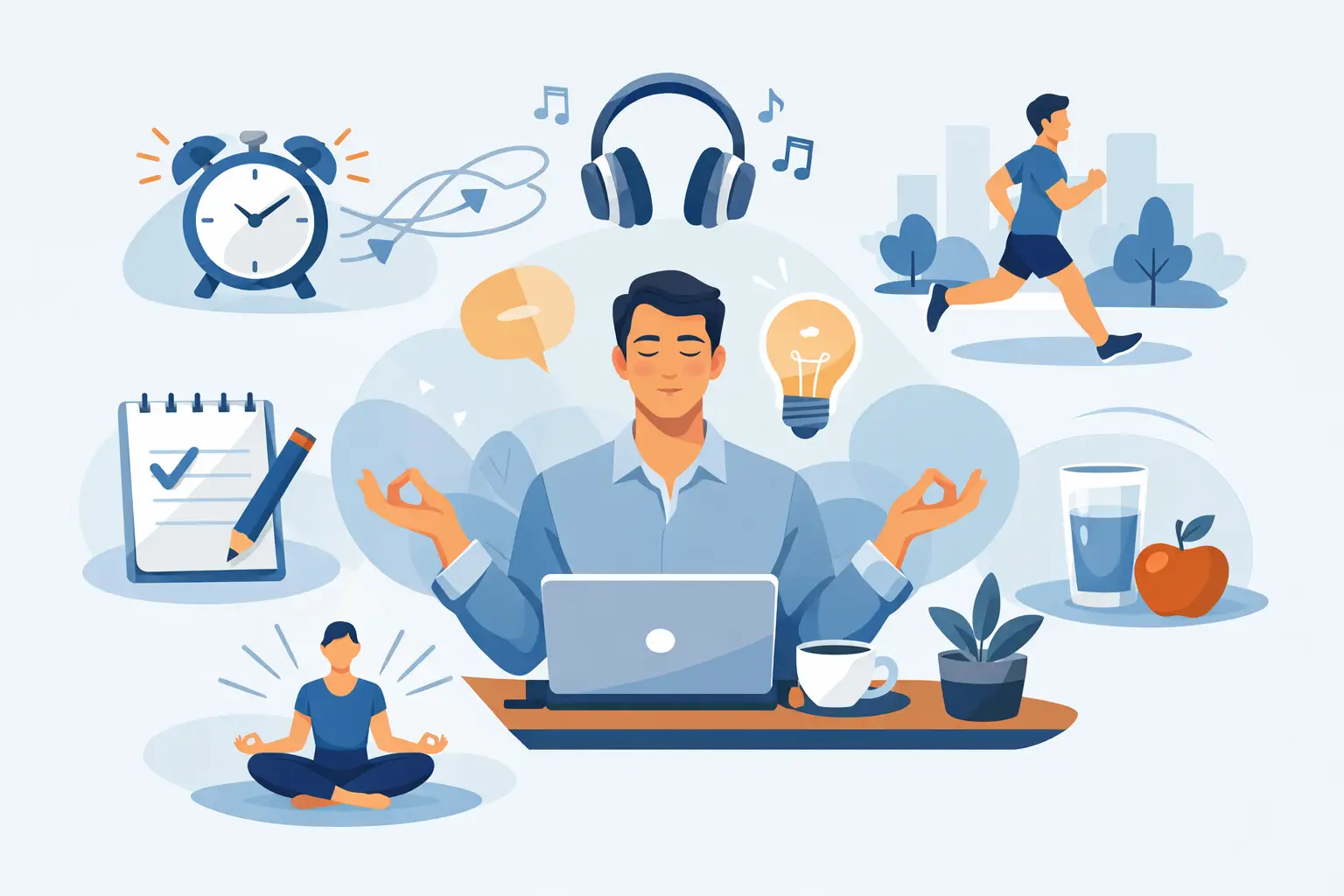
Some days, your brain feels like a browser with 27 tabs open. You sit down to work, but your attention keeps slipping – to messages, half-finished thoughts, low-grade stress, and the pressure to perform. If you want to know how to enter flow state, the answer usually is not more force. It is less friction.
Flow is not a rare peak reserved for elite athletes, artists, or founders on perfect mornings. It is a real, trainable condition where attention narrows, mental noise softens, and the work starts carrying you forward. You feel clear, absorbed, and effective at the same time. That is why flow matters so much for modern work. It is one of the few states that improves performance without making you feel more strained.
What flow state actually feels like
Flow is often described as deep focus, but that undersells it. Focus can still feel tense. Flow feels smoother. You are fully engaged, but not gripping. Time changes. Self-consciousness fades. The task becomes easier to stay with because your mind is no longer splitting its energy between the work and everything else.
There is also a physical side to it. Your breathing tends to settle. Your nervous system feels more regulated. You are alert, but not wired. This is one reason so many people struggle to access flow when they are stressed. A distracted mind is part of the problem, but an overstimulated body is often underneath it.
That is the key shift. If you have been treating flow like a motivation problem, you may be missing the real issue. For many high performers, the barrier is not laziness. It is cognitive clutter and nervous-system overload.
How to enter flow state without forcing it
The fastest way to make flow more available is to stop waiting for it to appear spontaneously. Build the conditions that make it more likely.
Start with a task that has a clear edge. Flow does not happen well in vague work. “Work on my business” is too broad. “Draft the opening section of the proposal” gives your mind something it can lock onto. Specificity lowers resistance because the brain does not have to keep deciding what to do next.
The task also needs the right level of challenge. Too easy, and your mind wanders. Too hard, and you tense up or avoid it. Flow tends to appear when the task stretches you, but does not flood you. That range is personal. It changes based on sleep, stress, and how mentally taxed you already are. On low-energy days, entering flow may require a smaller target.
Your environment matters more than most people want to admit. If your phone is visible, your inbox is open, and five tabs are pulling at your attention, you are not in a flow-friendly setup. You are in a tug-of-war. Reduce decision points. Clear the visual field. Remove alerts. Make it easier to stay than to switch.
Then create a transition ritual. This is where consistency starts. Flow is easier to access when your brain recognizes a repeatable cue that says, it is time to narrow attention now. That cue might be the same desk, the same headphones, the same breathing pattern, or the same 15-minute audio session before deep work. The ritual matters because it shortens the distance between scattered and focused.
Why calm helps performance
A lot of advice about productivity is built on stimulation. More urgency. More pressure. More push. That can work for short bursts, but it often backfires when the goal is sustained concentration.
Flow responds better to calm intensity. That means your mind is awake, but not noisy. Your body is settled, but not sleepy. You feel engaged without feeling chased. This is where people often get stuck. They want high output, so they keep using high stress to generate it. The result is inconsistency. Some days they can power through. Other days they burn out before they begin.
Learning how to enter flow state often comes down to nervous-system regulation as much as mindset. When the body reads the moment as safe enough to focus, attention stabilizes. You stop scanning for everything else. More energy becomes available for the task in front of you.
That is why short practices can be so effective. You do not always need an hour of meditation or a perfect morning routine. Sometimes you need a fast reset that lowers internal static and helps your brain shift gears. For people with demanding schedules, that simplicity matters.
A practical flow ritual you can use today https://flowwave-neuroflowlabs.lovable.app/
If you want a repeatable approach, keep it minimal. Complex systems often create their own resistance.
First, choose one meaningful task. Not three. Not your whole afternoon. One task that matters and can be advanced in the next 30 to 90 minutes. Give it a visible finish line so your brain knows what success looks like.
Next, reduce external friction. Put the phone out of reach. Close what you are not using. Keep only the materials needed for the task in front of you. This is simple, but it changes the quality of attention almost immediately.
Then spend a few minutes settling your state before you begin. Slow breathing works. So does a short audio-based focus ritual designed to calm mental noise while sharpening attention. For many people, this is the missing piece. They try to think their way into flow when what they actually need is a cleaner internal state. A revolutionary tool based on latest studies on gamma frequencies as The Flow Wave Audio can fit well here because it gives you a fast, repeatable entry point instead of asking you to manufacture focus from scratch.
Once you begin, protect the first ten minutes fiercely. This is the fragile window where the urge to switch tasks is strongest. Do not evaluate your performance too early. Do not ask whether you feel fully locked in yet. Stay with the task long enough for momentum to build. Flow often arrives after commitment, not before.
Finally, stop before you are completely fried. This sounds counterintuitive, but leaving a little energy in the tank makes it easier to return. If every deep work session ends in exhaustion, your brain starts associating focus with depletion. A better pattern is intensity with recovery.
What gets in the way of flow
Multitasking is the obvious one, but internal pressure is just as disruptive. If you sit down believing this session has to be brilliant, important, or proof of your capability, you create friction before the work even starts. Flow likes absorption, not self-surveillance.
Poor recovery also matters. If your sleep is off, your stress load is high, or your brain has been in constant input mode all day, flow will be harder to access. That does not mean the day is lost. It means your entry ramp may need to be gentler. Lower the challenge slightly. Extend the transition ritual. Aim for progress, not perfection.
There is also the problem of inconsistency. Many people only try to access flow when the stakes are high. That is like practicing a skill only during the championship game. Flow becomes more reliable when you rehearse entering it under normal conditions. A short daily practice works better than occasional heroic effort.
Make flow a pattern, not a lucky break
The people who seem to access flow on command usually are not relying on mood. They have a structure. They know what kind of work invites flow for them, what time of day they are most cognitively sharp, and what cues help them transition quickly.
That level of awareness does not have to become obsessive. In fact, keeping it simple is usually better. Notice when your best sessions happen. Notice what was present before them. Was the task clear? Was your body calm? Did you remove distractions? Did you use a ritual that signaled focus? Those patterns tell you more than generic productivity advice ever will.
If you are serious about learning how to enter flow state, think less about chasing a magical feeling and more about building reliable conditions. Clarity, challenge, calm, and repetition beat intensity alone.
The goal is not to become a machine. It is to make deep focus feel easier to access in a noisy world. When your mind is clear and your energy is steady, good work stops feeling so hard to begin. And that shift, practiced daily, can change far more than a single work session.