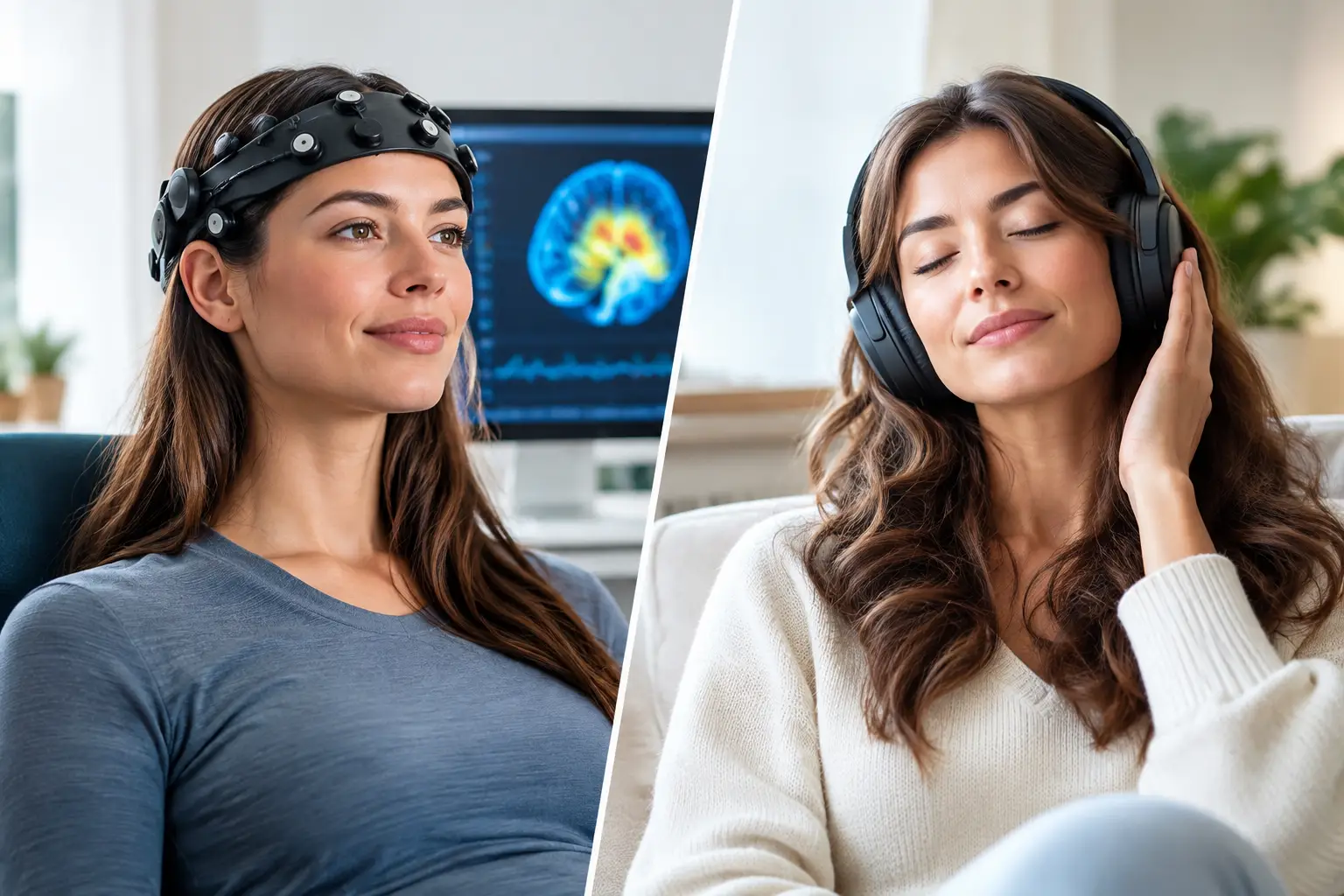
Your calendar is full, your inbox is louder than your best ideas, and by 3 p.m. even simple decisions can feel heavier than they should. When focus starts slipping, it is natural to look beyond another coffee or productivity app. The question of neurofeedback versus listening protocols comes down to a practical one: do you need a personalized clinical-style training process, or a simple daily tool that helps create the conditions for clearer, calmer work?
Both approaches aim to support brain function, attention, and emotional regulation. But they work very differently, require different levels of time and investment, and suit different goals. Knowing the distinction can save you from choosing an impressive-sounding solution that does not fit your real life.
What Neurofeedback Actually Does
Neurofeedback is a form of biofeedback that uses sensors, typically placed on the scalp, to measure electrical activity in the brain through EEG. That information is processed in real time. You might watch a screen, hear a tone, or play a simple game that changes as your brain activity shifts toward a selected target pattern.
The basic idea is learning through feedback. When the system detects activity associated with the training goal, it provides a reward signal. Over repeated sessions, the brain may learn to produce that pattern more consistently. Protocols vary widely. Some are designed around attention, relaxation, sleep, peak performance, or symptoms that should be assessed by a qualified healthcare professional.
This is not a passive experience. Even when you are sitting still, neurofeedback is an active training process. It often involves an assessment, a series of sessions, equipment, and a clinician or technician who can adjust the protocol based on response. That level of personalization can be valuable, especially when a person has complex or persistent concerns.
It also means results are not one-size-fits-all. Research on neurofeedback is promising in certain contexts, but protocols, study quality, and outcomes vary. A reputable provider should be clear about what the method can reasonably support, how progress will be measured, and when medical or mental health care is more appropriate.
What Listening Protocols Are Designed to Do
Listening protocols use sound to shape your mental environment. They may include music, rhythmic pulses, binaural or monaural beats, nature-based soundscapes, guided audio, or brainwave-entrainment patterns intended to encourage a particular state, such as relaxed alertness or sustained concentration.
Rather than measuring your individual brain activity and responding moment by moment, a listening protocol delivers a pre-designed auditory experience. You press play, wear headphones when required, and give your nervous system a consistent cue that it is time to settle, focus, reset, or transition into deep work.
That simplicity is the point. For a professional managing meetings, family responsibilities, and a demanding workload, a tool only helps if it can become a real habit. A 15-minute listening session can fit before a presentation, during a midday reset, or at the start of a distraction-free work block without adding another complicated routine to your day.
Listening protocols are not equivalent to medical treatment, and they should not be presented as a replacement for evaluation or care. Evidence for brainwave entrainment and audio-based focus tools is still developing, with individual response influenced by the type of audio, listening conditions, expectations, sleep, stress, and the task at hand. Still, many people find structured sound useful as a reliable cue for attention and calm.
Neurofeedback Versus Listening Protocols: The Key Difference
The clearest distinction is feedback. Neurofeedback is closed-loop: it measures your brain activity and adjusts or rewards based on what is happening in real time. Listening protocols are generally open-loop: they provide a consistent audio stimulus without measuring whether your brain has followed a specific pattern.
That difference affects nearly every practical consideration. Neurofeedback is usually more personalized and potentially more intensive. Listening protocols are more accessible, portable, and easier to repeat every day. One is a training relationship with a system, often a practitioner, and a schedule. The other is a self-directed performance ritual.
Neither approach automatically wins. The better choice depends on what you are trying to change and what you will actually use consistently.
Choose neurofeedback when personalization is the priority
Neurofeedback may be worth exploring if you want individualized EEG-informed training, have already discussed your concerns with a qualified professional, and can commit to a structured series of sessions. It can also appeal to people who like measurable data and want direct oversight while exploring attention, stress regulation, or performance goals.
Ask providers what equipment they use, how they select protocols, how many sessions they expect, what the total cost may be, and how they define improvement. Be cautious of anyone who guarantees sweeping results or suggests neurofeedback can replace appropriate medical or mental health treatment.
Choose listening protocols when consistency is the priority
Listening protocols make sense when your primary goal is to create a repeatable state-change practice with minimal friction. If brain fog appears before complex work, if your attention fractures after back-to-back calls, or if you need a cleaner transition from stress into focused effort, sound can become a practical anchor.
The strongest use case is not trying to force your brain into perfection. It is reducing the noise around focused work. Put the same audio on, remove easy distractions, define one meaningful task, and let repetition teach your mind that this is your time to concentrate.
For people who want that kind of low-effort daily practice, The FlowWave Audio uses a 15-minute sequence designed to move from Alpha into Gamma 40 Hz frequencies, paired with 432 Hz tones. It is built for the moment when you need to leave scattered thinking behind and begin work with more clarity, not add another demanding system to your routine. For readers who want more information about The Flowwave Audio, here is the link: https://flowwave-neuroflowlabs.lovable.app
The Trade-Offs That Matter in Real Life
Cost and convenience matter, but so does cognitive load. Neurofeedback can require appointments, equipment, travel or setup time, and sustained financial commitment. For some people, that structure creates accountability. For others, it becomes one more obligation competing for attention.
Listening protocols have a lower barrier to entry, but they require honest expectations. Audio may support a focus ritual, help you decompress, or make deep work feel easier to begin. It cannot erase chronic sleep deprivation, solve an unsustainable workload, or diagnose the cause of ongoing cognitive changes.
Think of a listening protocol as part of your performance environment. Your hydration, sleep, movement, task design, notifications, and recovery still matter. The audio works best when it supports a clear intention rather than asking it to carry your entire day.
There is also a sensory preference factor. Some people find rhythmic sound deeply settling. Others are sensitive to headphones, repetitive tones, or certain frequencies. Start with a comfortable volume, use the protocol during a low-stakes work period, and notice whether you feel more settled and engaged or simply distracted.
A Smarter Way to Test What Helps
Do not judge either option by how dramatic it feels on day one. A better test is whether it improves the quality of your next hour. Before using a listening protocol, choose a task with a visible finish line: outline the proposal, review the numbers, write the first 300 words, or prepare for the difficult conversation.
Use the same protocol at roughly the same time for one to two weeks. Notice how quickly you begin, how often you switch tasks, and how mentally depleted you feel afterward. You are looking for a repeatable pattern, not a magical sensation.
If your focus struggles are sudden, severe, or tied to depression, anxiety, trauma, substance use, sleep disorders, medication changes, or neurological symptoms, start with a licensed healthcare professional. A performance tool can be supportive, but it should not delay care when something bigger may be asking for attention.
The most useful brain-optimization practice is usually the one that respects your capacity. If a personalized training program is right for you, pursue it thoughtfully. If what you need is a calm, consistent doorway into better work, give yourself 15 protected minutes, press play, and let focus become a practice you can return to.
Leave a Reply