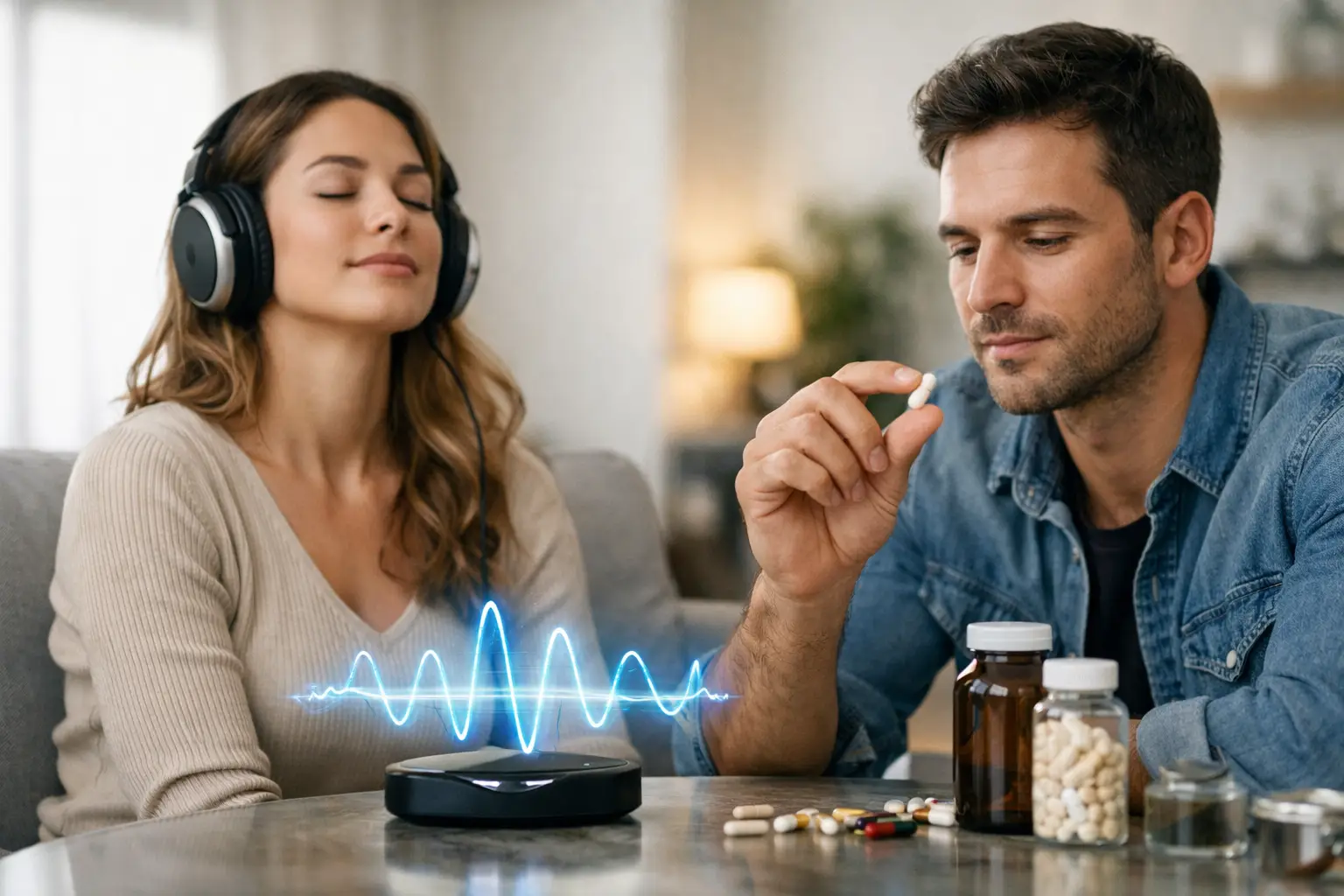
If your desk drawer has become a graveyard of half-used focus supplements, you are not imagining the pattern. Many high-performers start with nootropics because they want a sharper mind fast, then realize the real challenge is not finding a pill. It is finding something sustainable. That is where brainwave entrainment compared to nootropics becomes a much more useful conversation.
Both approaches aim at the same goal: better focus, clearer thinking, stronger mental stamina, and fewer days lost to brain fog. But they get there in very different ways. One changes your internal state through sound and frequency guidance. The other usually relies on compounds that affect neurotransmitters, blood flow, alertness, or stress response. For ambitious professionals who want consistent performance without building a complicated stack, the difference matters.
Brainwave entrainment compared to nootropics: the core difference
The simplest way to think about it is this. Nootropics try to influence brain performance through ingredients. Brainwave entrainment tries to influence brain state through rhythmic auditory stimulation.
That distinction may sound subtle, but in day-to-day life it feels very different. With nootropics, you are often asking, “What should I take, how much, and when?” With entrainment, you are asking, “What state do I want my brain to enter, and can I get there reliably?”
For many adults juggling work, family, and constant digital input, state management is the deeper issue. You may not lack motivation. You may lack the ability to shift quickly from scattered and overstimulated into calm, focused, and fully engaged. That is where entrainment can feel refreshingly direct.
How nootropics help, and where they can fall short
Nootropics cover a wide range. Some are stimulant-leaning. Some support memory. Some are marketed for stress, clarity, or mood. A few have decent research behind specific ingredients. Others are mostly branding, caffeine, and hope.
At their best, nootropics can help with alertness, mental energy, reaction time, and perceived cognitive performance. If someone is sleep-deprived, under high stress, or dragging through an afternoon slump, a well-chosen formula may create a noticeable lift.
The trade-off is that nootropics are rarely friction-free. Results can vary based on body chemistry, tolerance, dosage, sleep quality, hydration, diet, and whether the formula actually contains meaningful amounts of active ingredients. Some people feel more focused. Others feel jittery, flat, or oddly wired. And even when a supplement works, the effect may be inconsistent from one day to the next.
There is also a psychological cost that does not get discussed enough. Once focus becomes associated with taking something, people can start to feel dependent on their stack to do their best thinking. That can quietly erode confidence in their natural capacity to concentrate.
What brainwave entrainment does differently
Brainwave entrainment works by using rhythmic sound patterns to encourage the brain to synchronize with targeted frequencies. Different frequency ranges are associated with different mental states. Alpha is often linked to relaxed alertness. Gamma is commonly associated with heightened attention, integration, and cognitive processing.
In practical terms, entrainment is less about stimulation and more about guidance. Instead of pushing your system harder, it helps organize your mental state. That is a meaningful difference if your biggest issue is not low ambition, but mental noise.
Many people do not need more intensity. They need less internal friction. They need the feeling of sitting down to work and having their mind cooperate.
That is why audio-based brain optimization appeals to professionals who are tired of cycling between over-caffeinated and mentally drained. A short, structured listening session can become a reliable transition into focus without pills, powders, or guesswork.
Brainwave entrainment compared to nootropics for focus
If your goal is immediate sharpness, nootropics can sometimes feel faster. A stimulant-based product may create a noticeable surge in alertness within a short window. But alertness is not always the same as deep focus.
You already know the difference. Alertness can feel like having ten tabs open in your head. Deep focus feels quiet, precise, and absorbed.
That is where entrainment often has the edge. It is designed to support the conditions that make flow possible: reduced mental chatter, sustained attention, and a smoother path into concentrated work. Instead of spiking your system, it helps your brain settle into a more productive rhythm.
For creatives, founders, executives, and knowledge workers, that distinction matters more than a quick burst of energy. The real win is not feeling amped up. It is being able to think clearly for long enough to do meaningful work.
What about memory, stress, and mental fatigue?
This is where the comparison gets more nuanced.
Some nootropics are marketed heavily for memory support, and certain ingredients may help specific aspects of cognition over time. But memory is not only about chemistry. It is also affected by attention, stress load, sleep, and whether your brain is overloaded when information comes in.
If you are distracted, tense, and mentally exhausted, better recall often starts with better state regulation. Brainwave entrainment may support memory indirectly by helping you become more present, less scattered, and less cognitively taxed. It does not replace healthy sleep or medical care, but it can support the mental conditions where memory performs better.
Stress is another dividing line. Some nootropics try to smooth stress while supporting focus, but others can increase internal tension, especially in sensitive users. Entrainment tends to feel gentler. It can help calm the nervous system while preserving alertness, which is especially valuable for people who need to perform without feeling overstimulated.
Mental fatigue is similar. If fatigue comes from depletion, nootropic stimulation may mask the feeling temporarily. If fatigue comes from cognitive overload, entrainment may address the experience more directly by helping your brain shift out of constant friction.
Who tends to benefit more from each approach?
Nootropics may make sense for people who enjoy experimentation, respond well to supplements, and are comfortable adjusting ingredients and timing. They can also be useful when a temporary boost is the priority.
Brainwave entrainment tends to fit people who want consistency, simplicity, and a lower-effort path to better focus. If you are already managing a busy calendar, a demanding workload, and too many decisions, adding another supplement routine may not feel like optimization. It may feel like one more thing to manage.
That is why a premium audio protocol can be so appealing. You press play, give it 15 minutes, and let your brain shift. No pills, no cycling formulas, no trying to decode labels before your first meeting.
For readers looking for a clean, practical option, The FlowWave Audio “Unlock Your Deep Flow” at https://flowwave-neuroflowlabs.lovable.app is built around that exact need. It uses a precise Alpha to Gamma 40 Hz sequence with 432 Hz tones to support deep focus, sharper memory, and reduced mental fatigue in a format that fits real life. When your mind starts associating one simple daily ritual with clarity and momentum, focus stops feeling forced. It starts feeling available again.
The real question is not which is stronger
It is which approach creates the kind of cognitive performance you can actually live with.
For some people, nootropics and brainwave entrainment are not mutually exclusive. A carefully chosen supplement and a structured audio protocol can coexist. But if you are deciding where to start, it makes sense to begin with the option that has fewer moving parts and less downside.
That is especially true if your main complaints are brain fog, scattered attention, and difficulty entering flow on demand. Those challenges are often less about needing more stimulation and more about needing better regulation.
And regulation is what high performers quietly depend on. Not hype. Not a stronger buzz. Just the ability to sit down, focus deeply, and stay mentally clear without paying for it later.
There is a reason many people eventually move away from complicated stacks and toward simpler nervous system support. The older you get, the more you value tools that work with your brain instead of constantly pushing it.
If you have been chasing clarity through capsules and still feel inconsistent, that is not failure. It is feedback. Your brain may not need more input. It may need a better rhythm.
A calmer, sharper, more reliable mind is not always built by adding more. Sometimes it starts when you remove the friction and give your brain a repeatable way to find its best state again.